
A Visual Recap of Wijk aan Zee 2026
Summarizing the first super tournament of the year in 8 graphs

As every year, the tournament in Wijk aan Zee was really exciting, with the world champion and 4 candidates participating in this year’s edition. I want to take a closer look at both the masters and the challengers section.
Masters section
Score
When looking at the score of the players, I always like to split the score between white and black games.
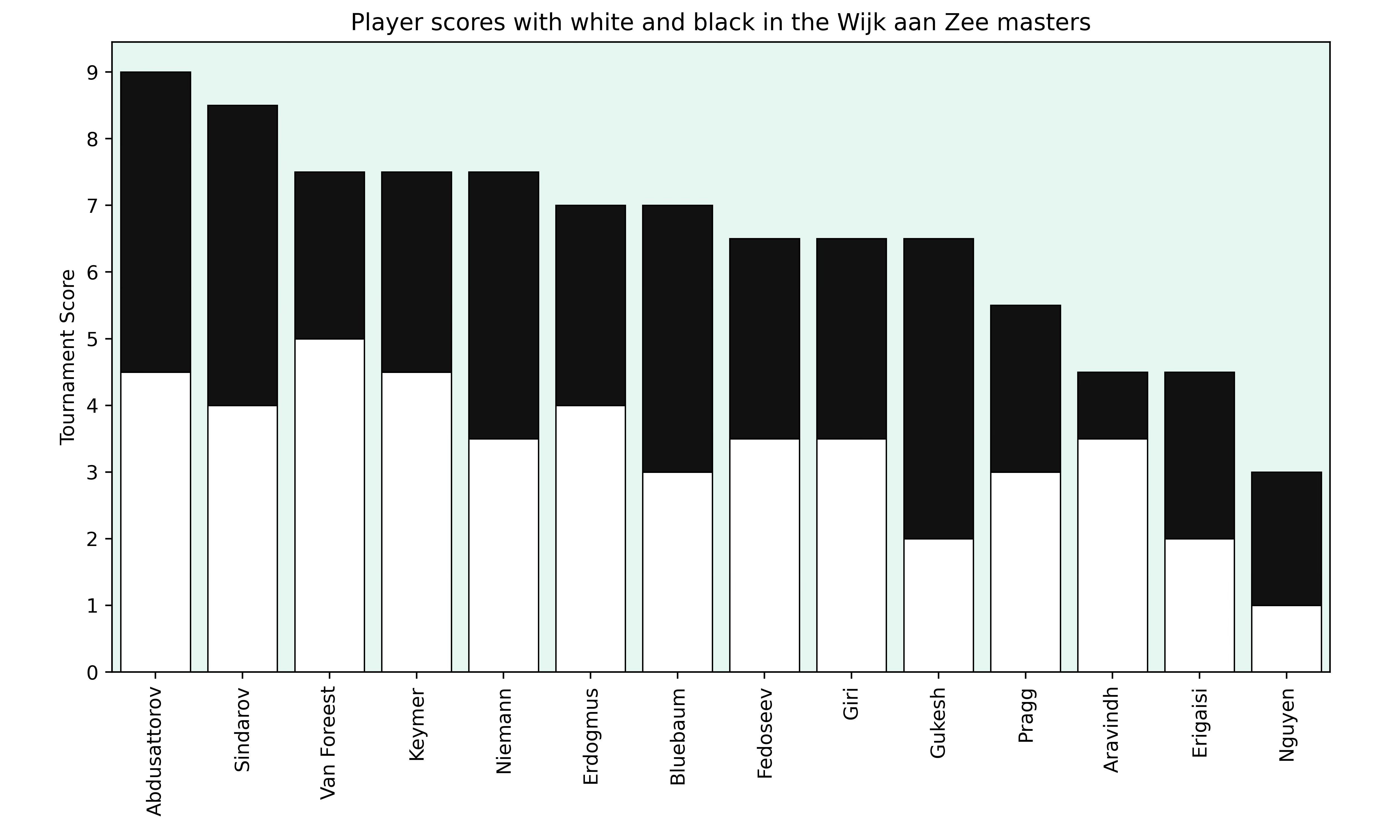
Most players scored evenly with both colors, but van Foreest and Aravindh were struggling a bit with black, while Gukesh interestingly scored much better with the black pieces.
While watching the tournament, I noticed that Keymer made hardly any draws, so I also wanted to take a look at the relative number of decisive games by each player.
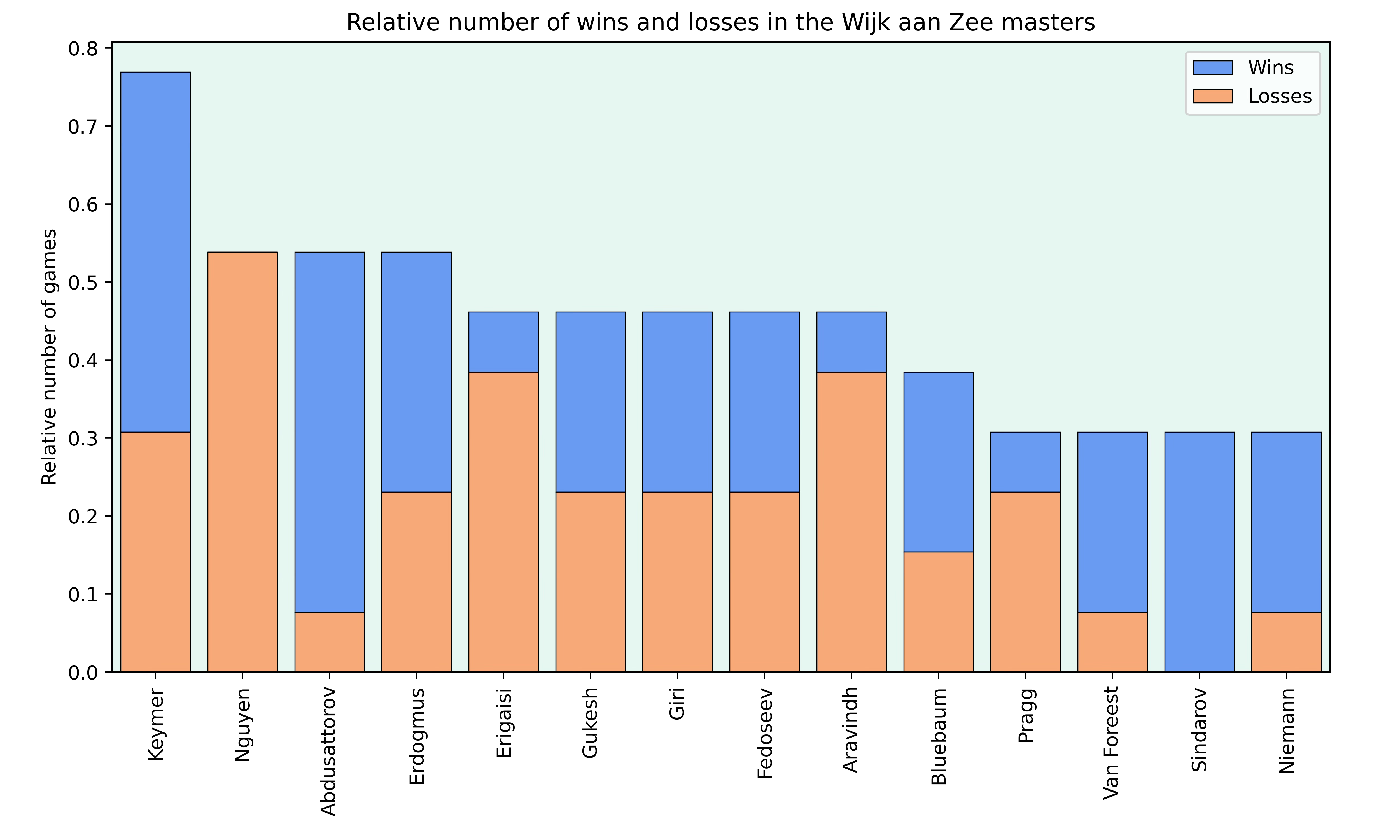
Amazingly, Keymer only drew 3 out of his 13 games and he landed on a +2 score, which is a good overall result. Another interesting point is that 4 of the 5 players with the least decisive games landed on a plus score, which may be a sign that preserving energy is a good strategy.
Better and worse positions
Looking at the results of the games gives only limited insight into the tournament, as the games can have many twists and turns. To get a better understanding of what was going on, I like to look at how the engine evaluates the position the players got.
First of all, I want to look at the relative number of moves where the players stood much better (evaluation of more than +1), slightly better (evaluation between +0.5 and +1), equal (evaluation between -0.5 and +0.5), slightly worse and much worse.
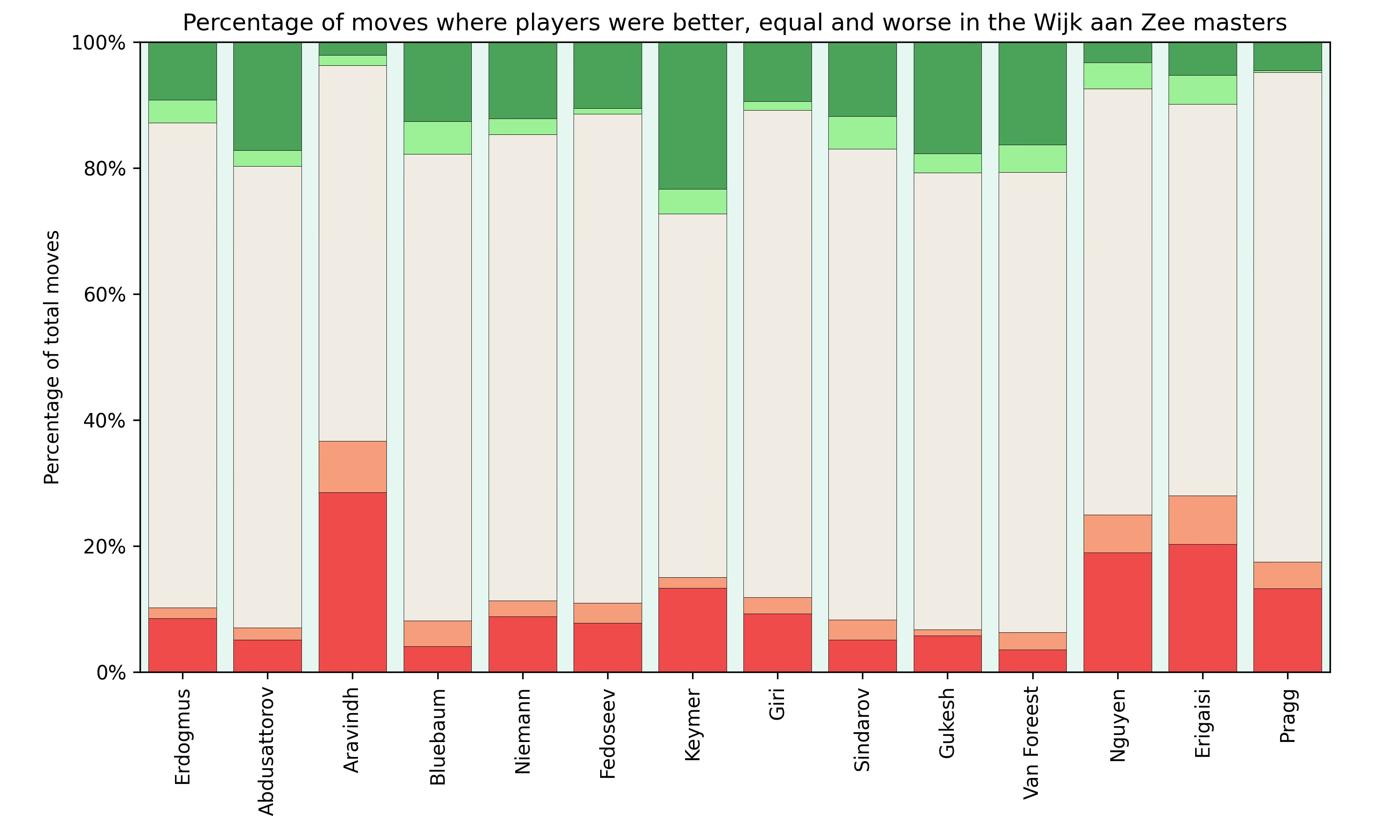
One can clearly see that the bottom 4 finishers had a rough time. But interestingly, Nguyen who finished last, had fewer worse positions than Aravindh and Erigaisi, which is probably an indication of the style of the latter two.
Keymer’s wild results are also reflected here, with the most good positions and also quite a few bad positions.
Having good positions is nice, but the only important thing is how many games the players actually won. So let’s look at the number of better games compared to the number of wins.
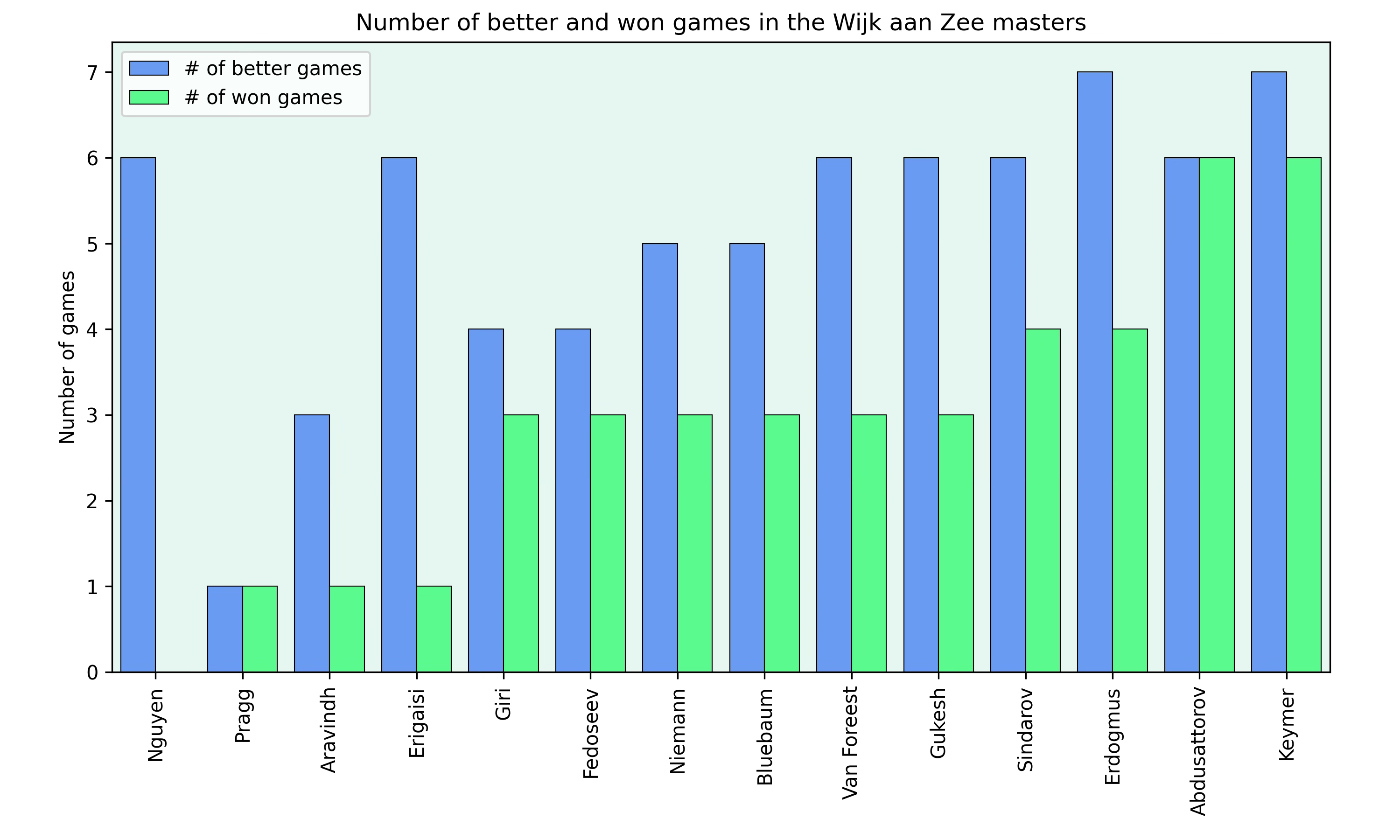
This graph looks rough from Nguyen’s perspective, since he had 6 games where he stood better, but couldn’t convert any of those (the time control without an increment before move 40 probably played a part in this). Erigaisi also missed a lot of chances, while the tournament winner Abdusattorov converted all his better positions into wins.
It also looks like Pragg had a very difficult tournament, as he was only better in a single game out of 13 rounds.
We can also look at how well players managed to defend worse positions, by seeing how many games they lost and how often they ended up in a worse position.
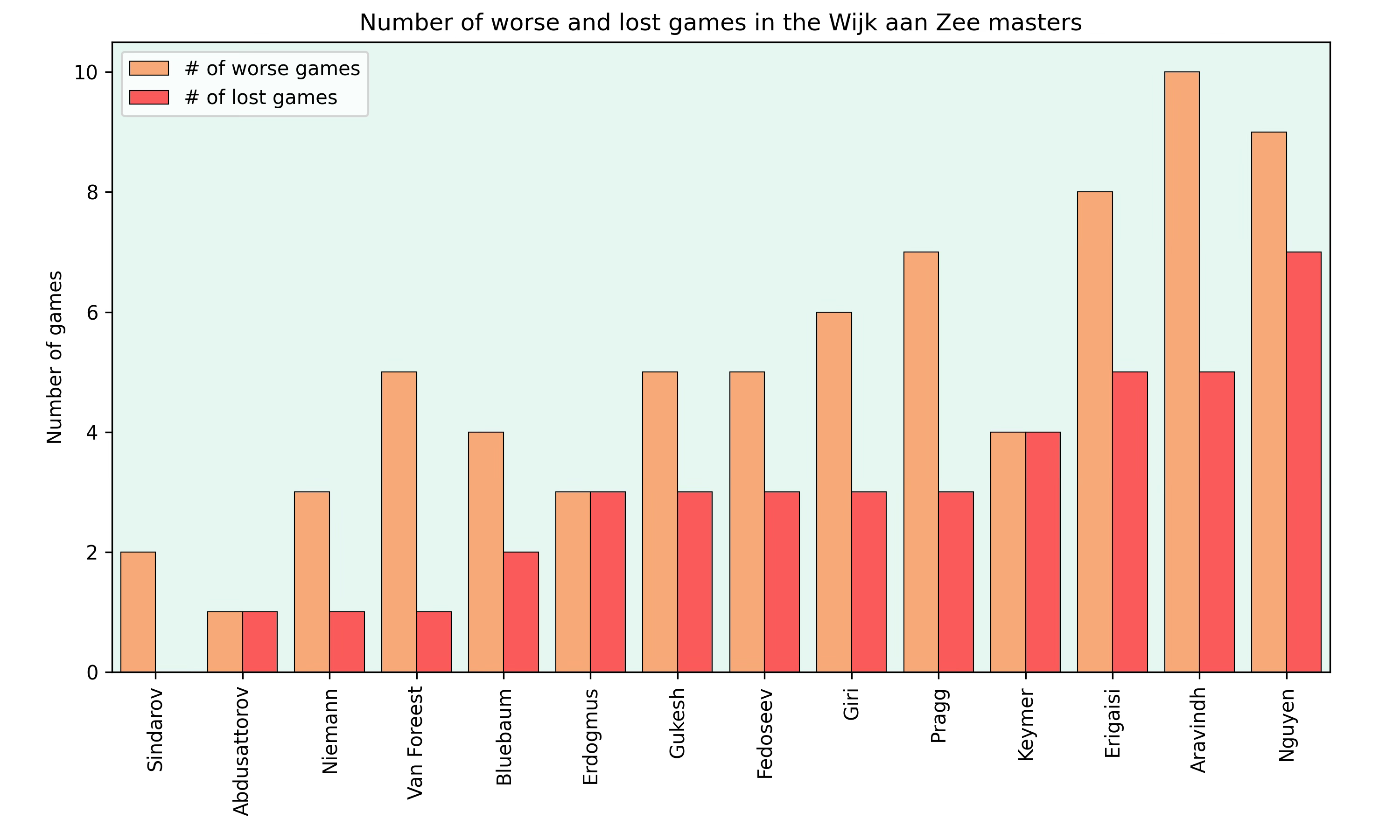
Again, Abdusattorov looks impressive here, as he was only worse in one game. Sindarov was the only player who remained undefeated, since he held on to 2 worse games.
One can again see that the games of Aravindh and Erigaisi were probably quite complicated, as they ended up in trouble more often than not, but they didn’t lose too many of those games.
Openings
One thing I haven’t looked at in the past are the openings played in the event. However, I want to do that more in the future, so let’s look at the openings played in the masters section.
Note that I grouped the openings based on their names and didn’t count each individual variation, as this would yield way too many different lines. All openings which appeared in at most 2 games are grouped in “Other”.
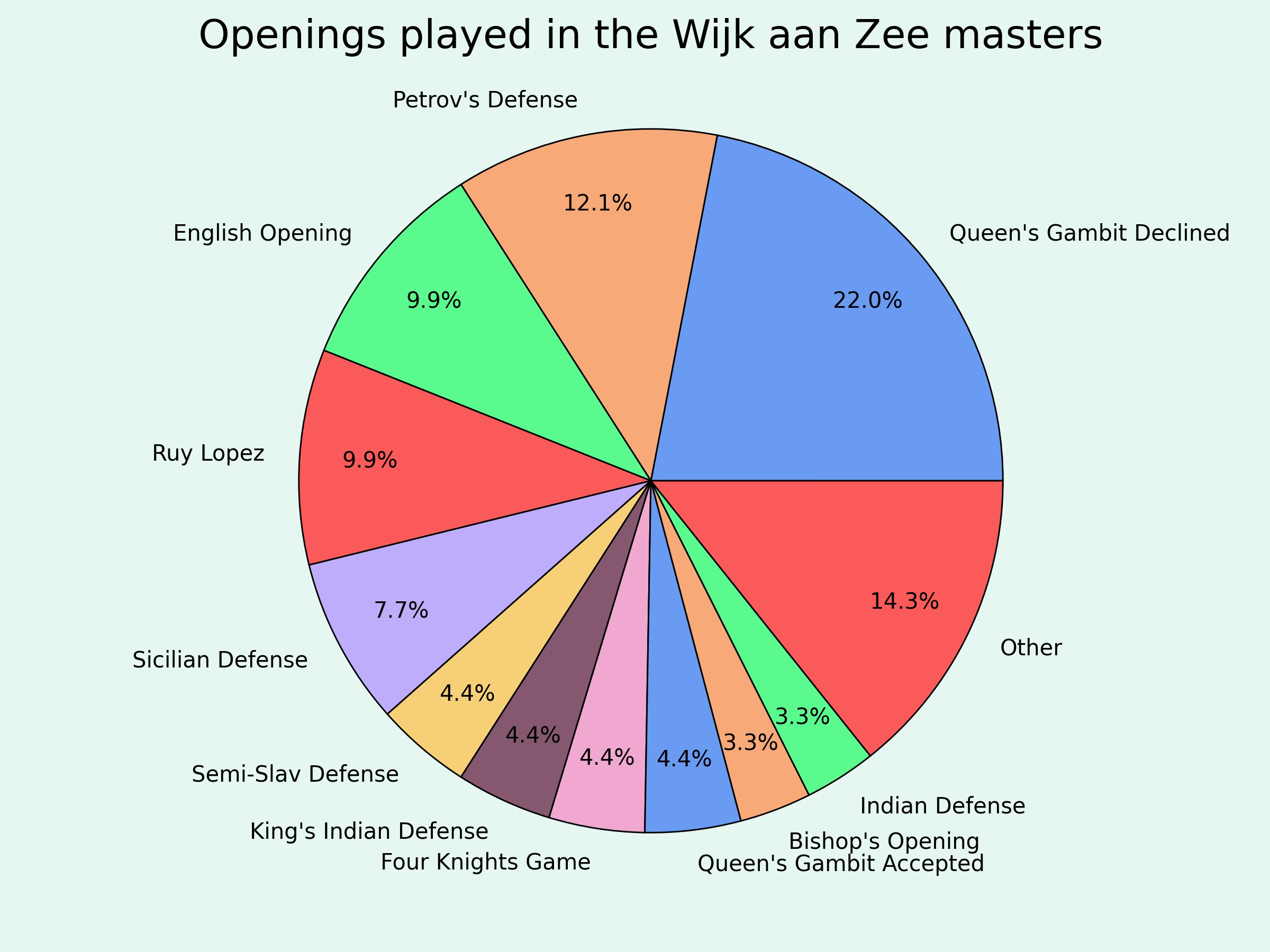
It’s interesting to see that the queen’s gambit declined was much more popular than other variations, but I guess this makes sense as there seem to be way more choices after 1.e4 compared to 1.d4.
Engine analysis
There were some surprising blunders in the tournament, especially in the first round. So let’s look at the inaccuracies, mistakes and blunders next.
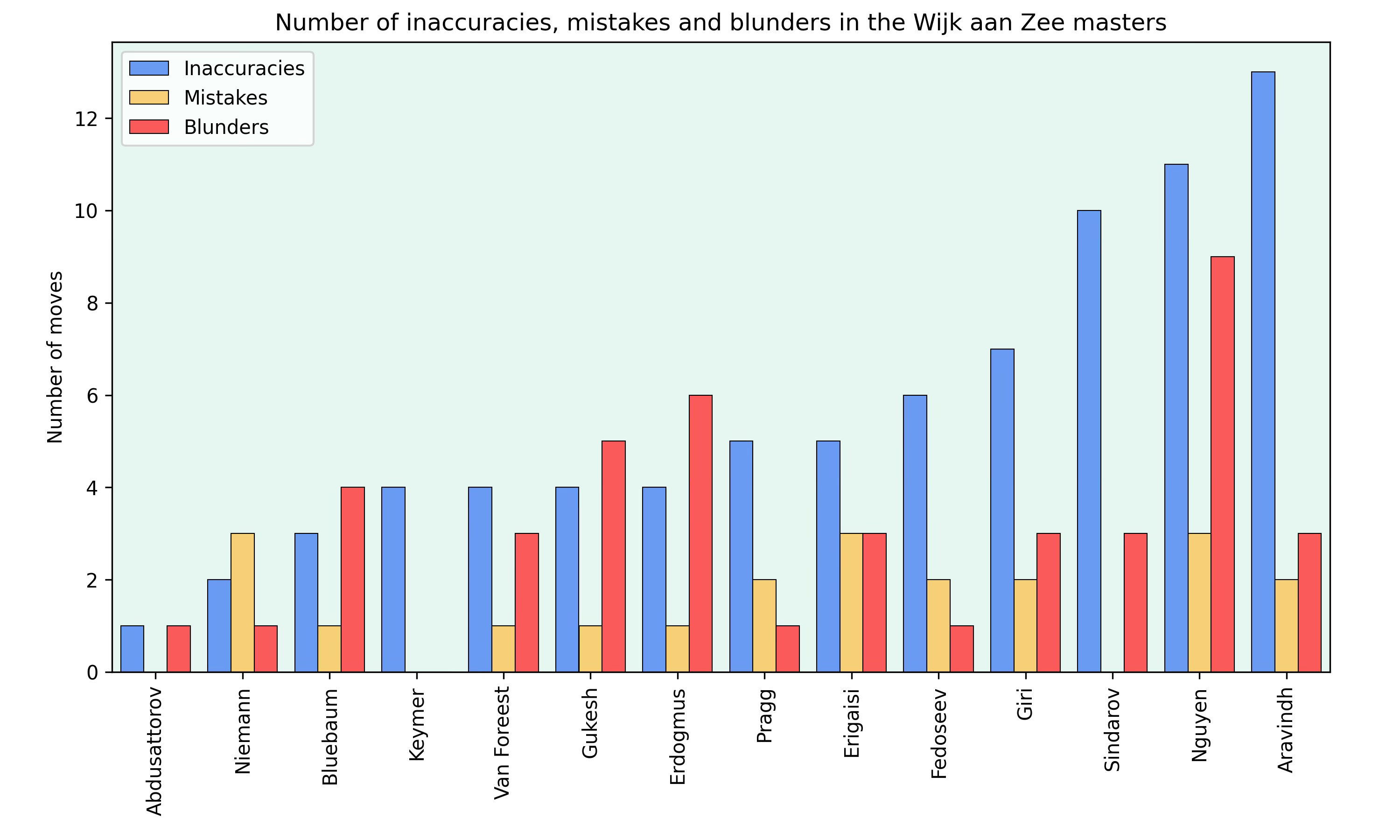
There were more blunders than last year, but the numbers don’t seem too crazy, especially for the 2700+ players.
One interesting detail is that despite Keymer’s losses, there wasn’t a single mistake or blunder according to the engine, which is very unusual. Abdusattorov’s performance again looks very impressive.
Finally, we can also take a look at the accuracy of the players. As the accuracy heavily depends on the kind of positions a player got, I always like to compare a player’s accuracy to that of their opponents in the games.
Note that I use my own accuracy formula based on OTB grandmaster games, which means that the numbers are lower than the scores used by online sites.
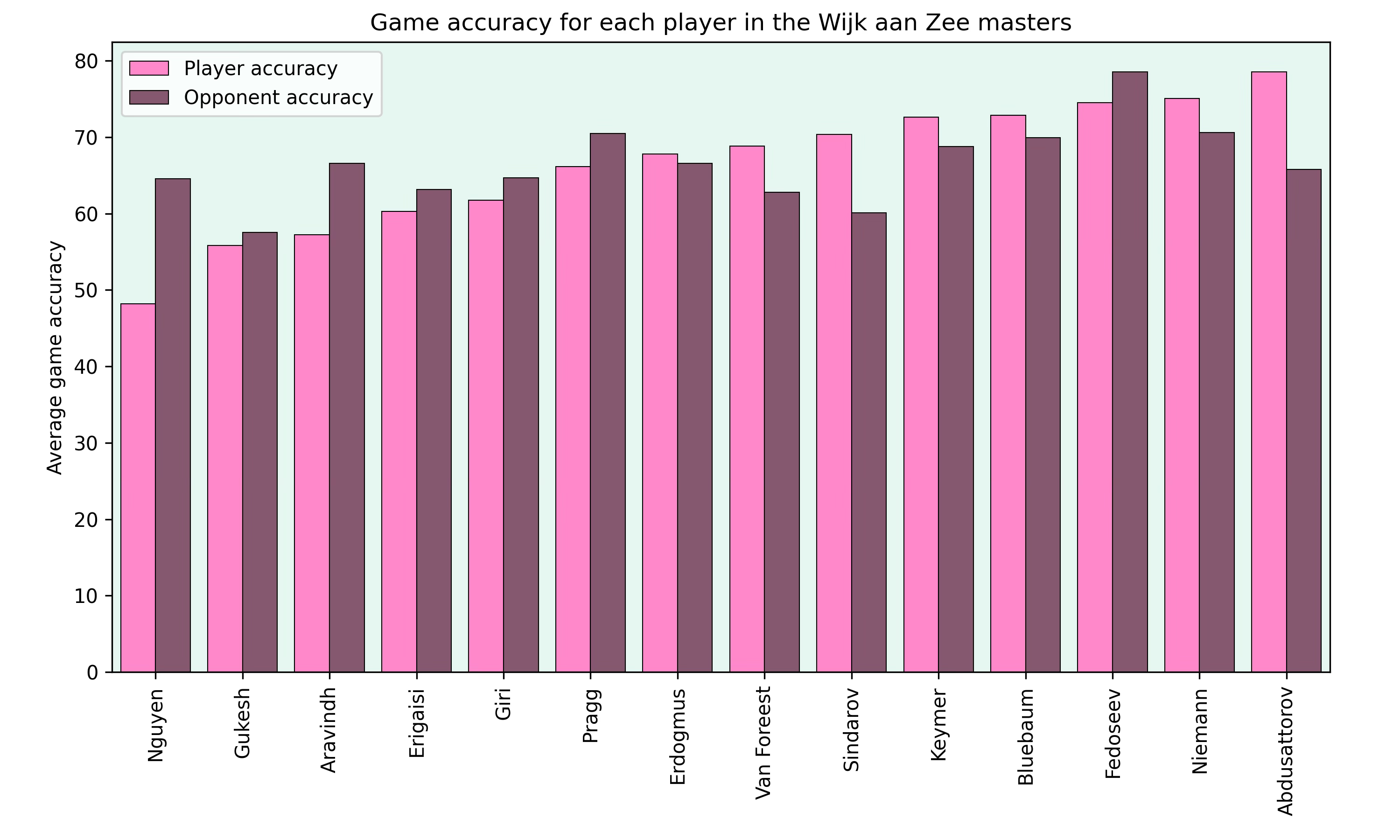
Abdusattorov had the highest accuracy and considering that his opponents found the positions much more difficult to handle, this really speaks for his play in the tournament. Sindarov also managed to play much more accurate than his opponents, which lead to his second place.
Challengers section
The challengers section is also always exciting to follow, as the organisers always invite an interesting mix of players, including many up and coming players some veterans. The spot in next year’s masters section is also always a great prize for first place.
I’ll go through the same plots as I did for the masters section, starting with the scores of the players.
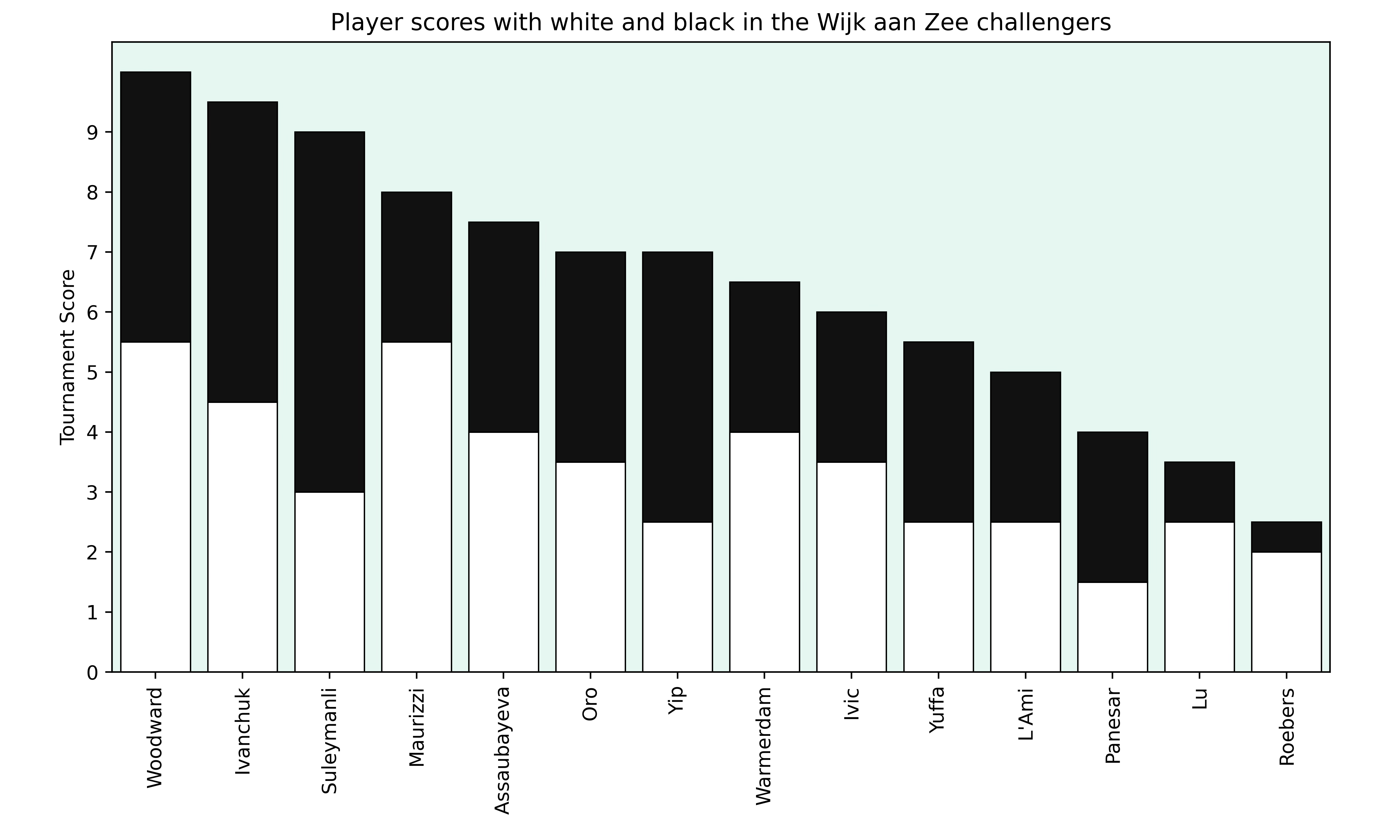
Unlike the masters section, there was a bit of back and forth in the fight for the lead between Woodward and Suleymanli, with Ivanchuk also getting close towards the end. We can take a closer look at this fight for first place.
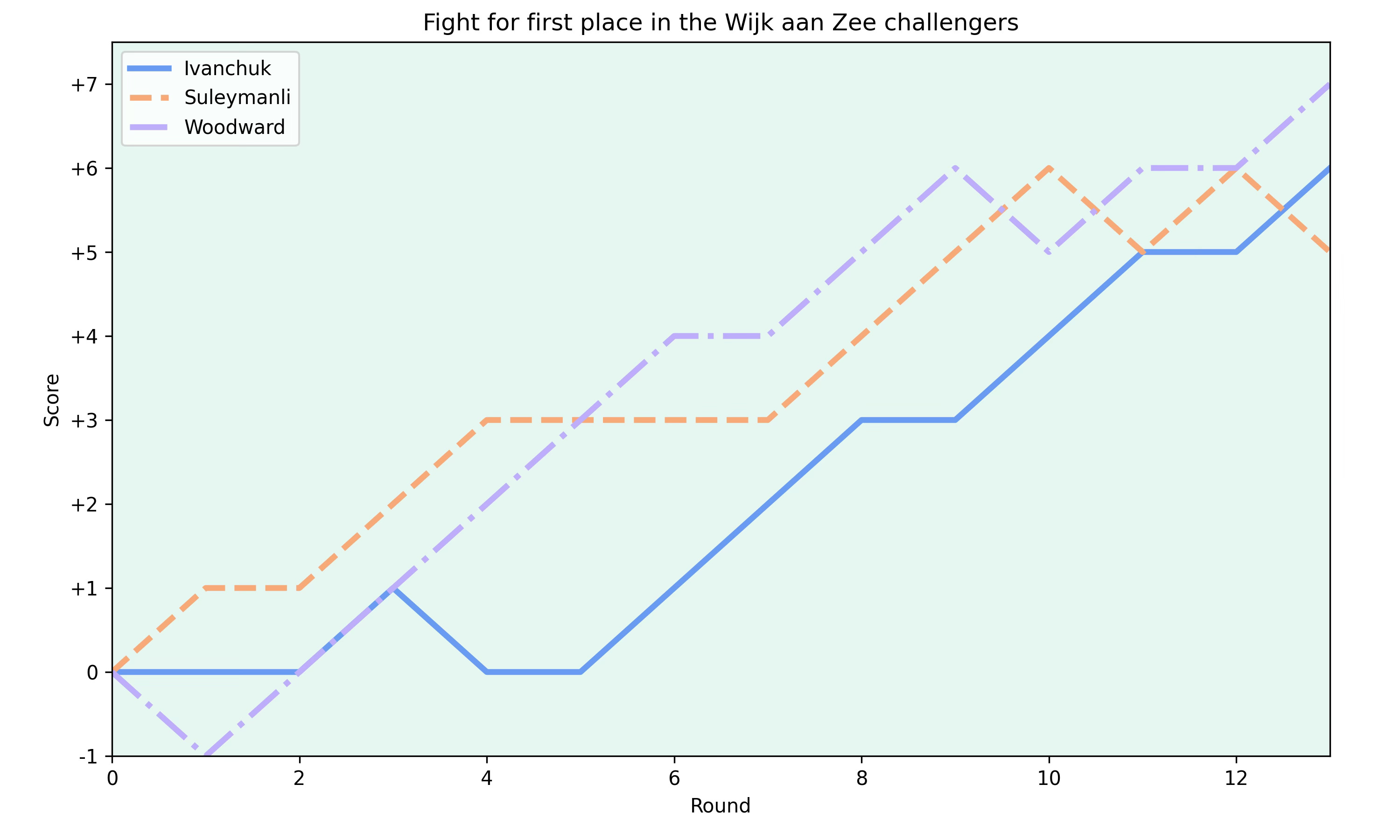
Woodward started out with a loss, but then went on an amazing streak and scored 8.5 out of 9 to take the tournament lead. However, he lost to Ivanchuk in round 10, which allowed Suleymanli to take the lead and, after a slow start, Ivanchuk got into the fight for the lead as well. In the end, Woodward managed to secure first place by winning the last round, only half a point ahead of Ivanchuk.
As one would expect, there were more decisive games in the challenger section compared to the masters, due to the bigger rating spread of the players.
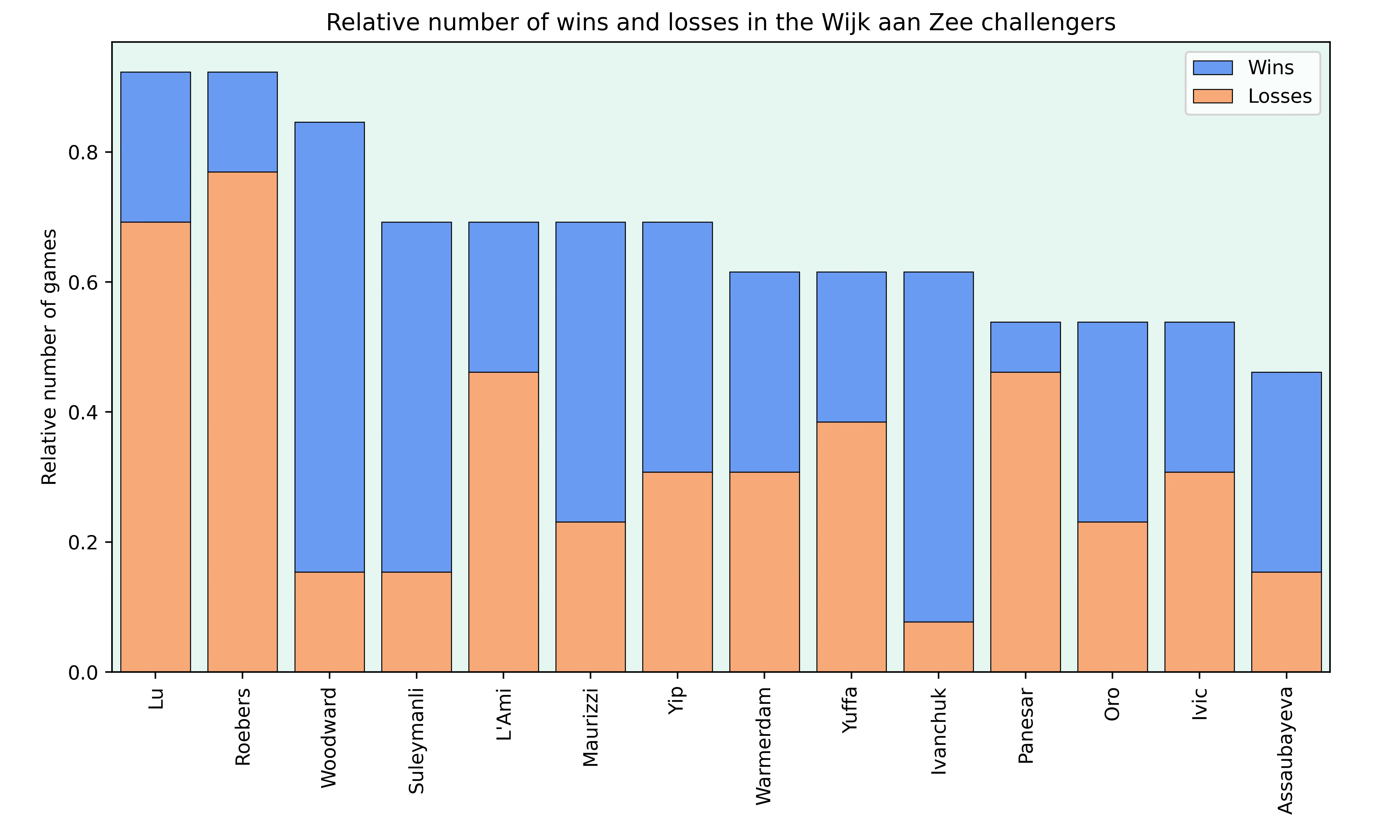
Woodward managed to win over 60% of his games, which is an incredible performance.
Better and worse positions
As we did for the masters section, let’s look at how often the players stood better and worse.
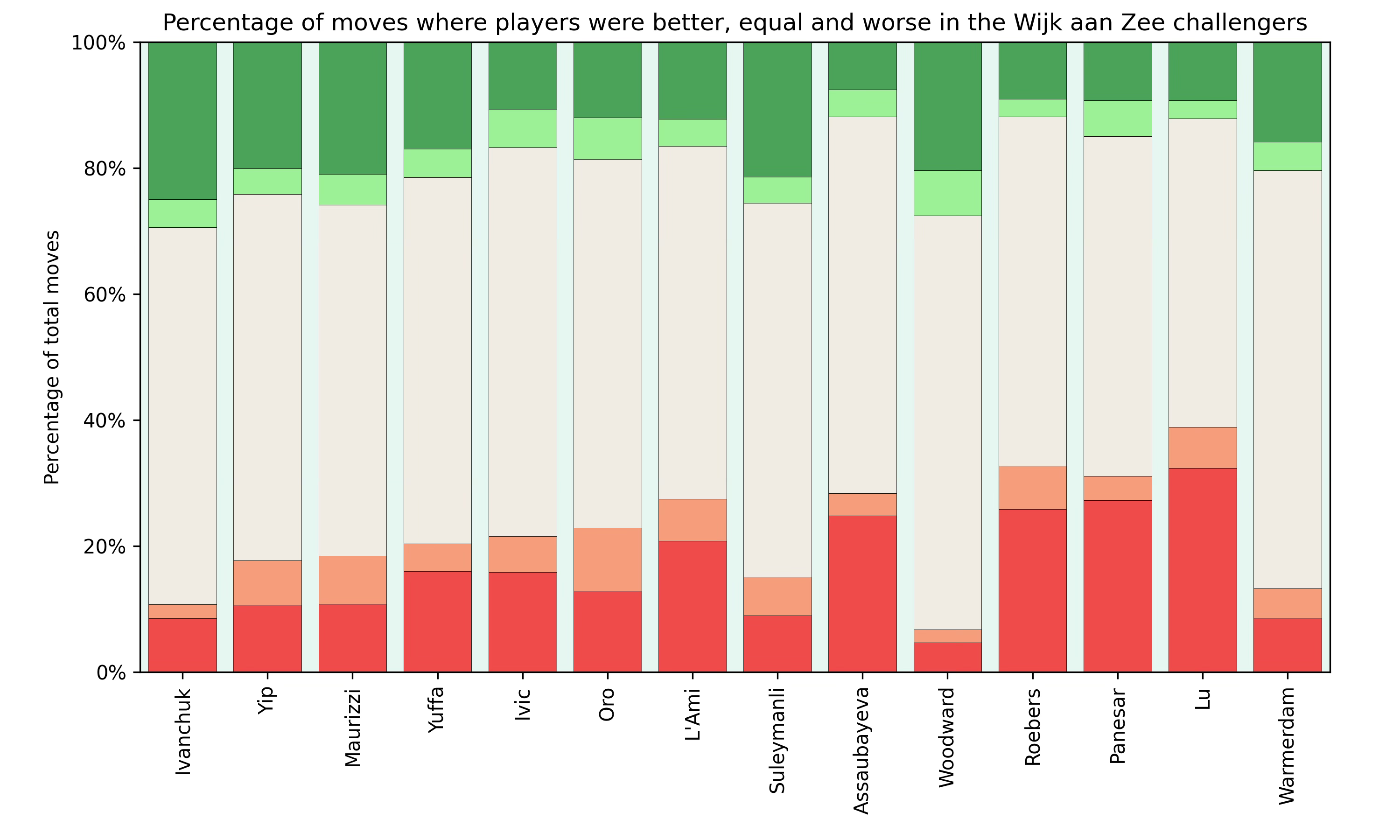
This once again shows that Woodward had a great tournament, he had the fewest bad positions and the most good ones. Ivanchuk’s tournament also looks very strong in this graph.
This trend continues when looking at the number of games with better positions and wins.
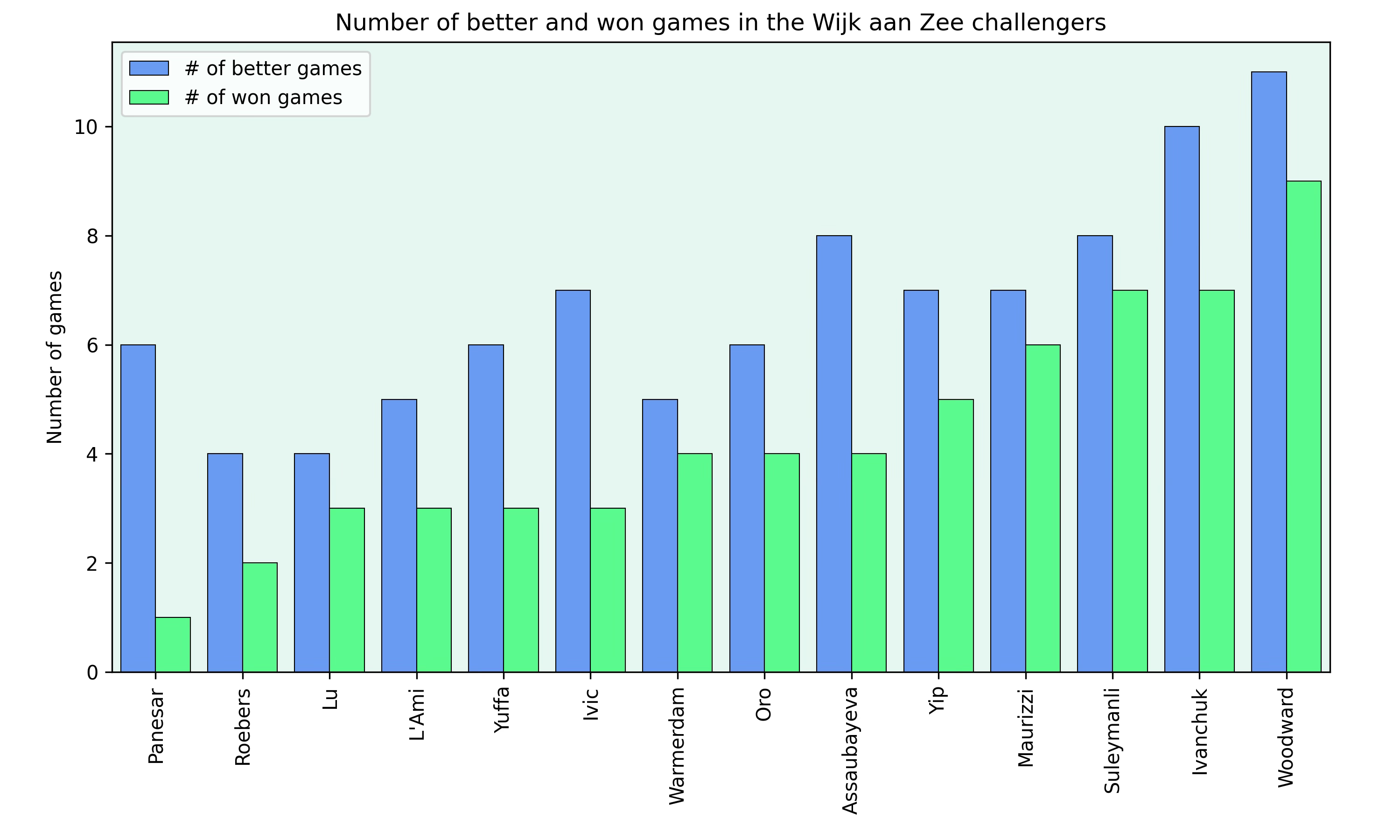
Woodward and Ivanchuk had the most games with better positions, but Woodward managed to convert 2 more of those. Meanwhile, Panesar struggled to convert his good positions in this tournament.
The top two finishers also had the fewest games with bad positions in the tournament.
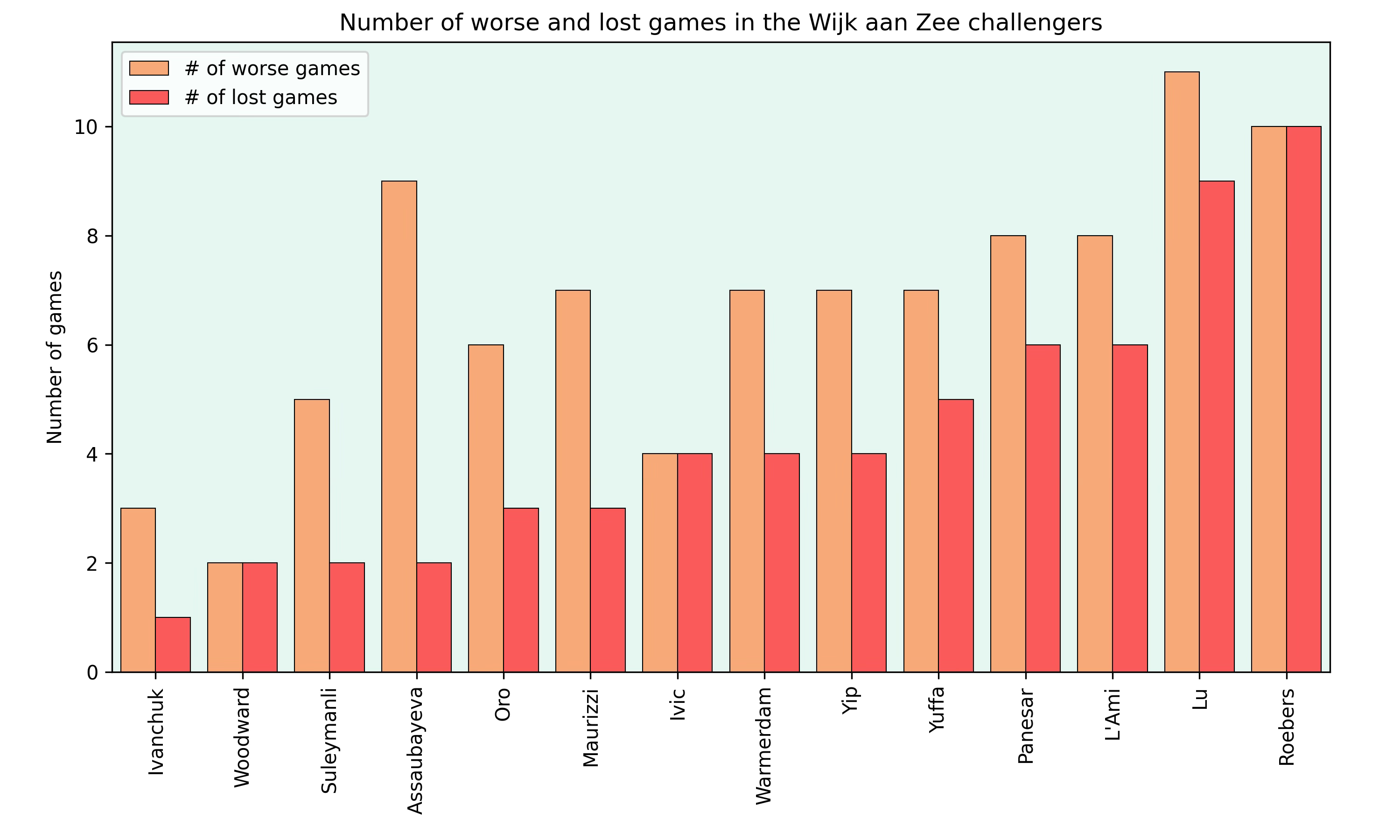
Amazingly, Assaubayeva was worse in 9 of her games, but only lost 2 of those. Only Roebers and Lu had more bad positions, but they weren’t nearly as successful in saving them.
Openings
Interestingly, the opening frequency was very different to the masters section.
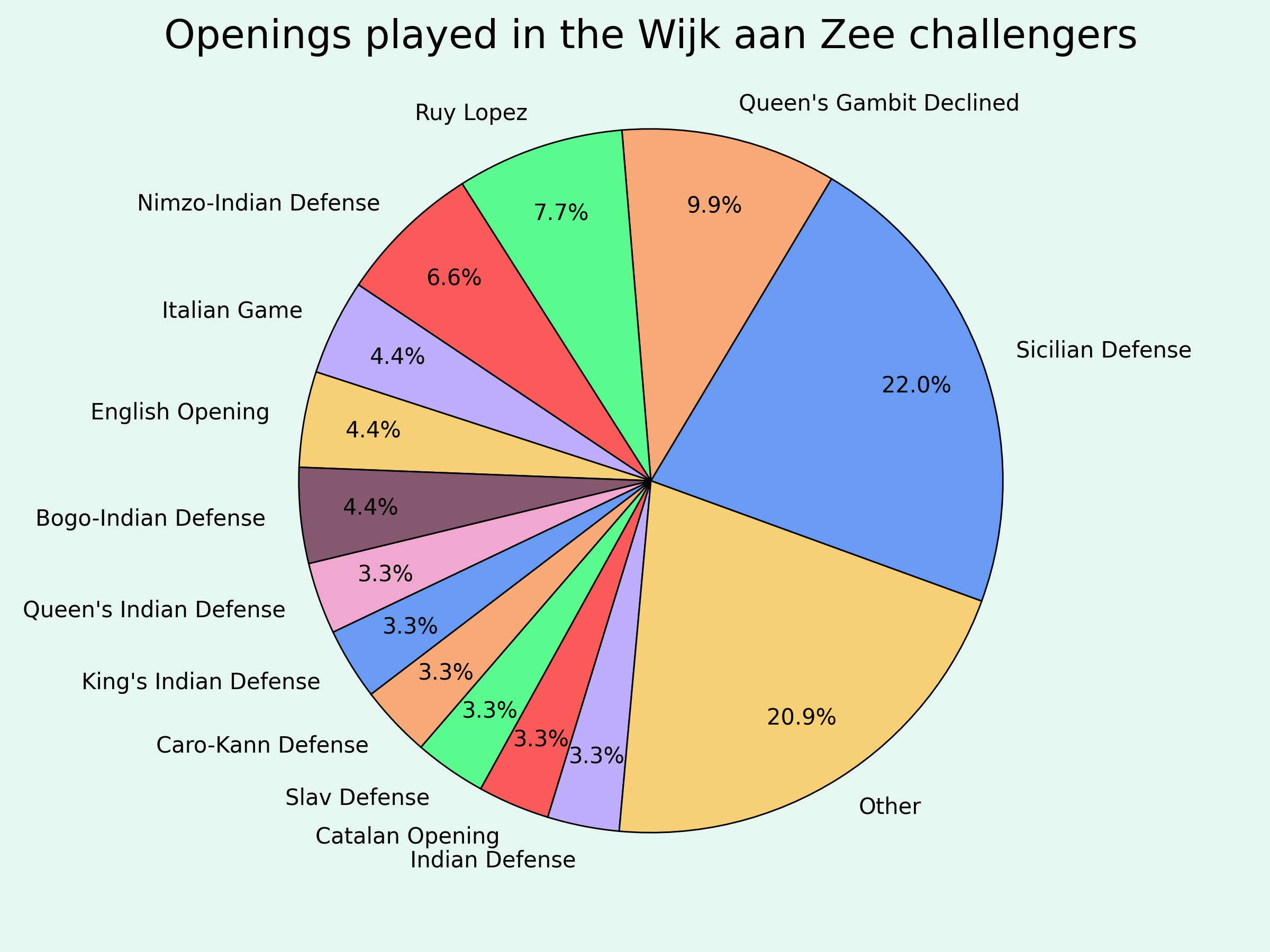
The most common opening was the Sicilian and, in contrast to the masters section, there is not Petrov to be seen. There were also more different openings, with 20% of openings played in at most 2 games.
Engine analysis
Finally, let’s look at the quality of play in the challengers section.
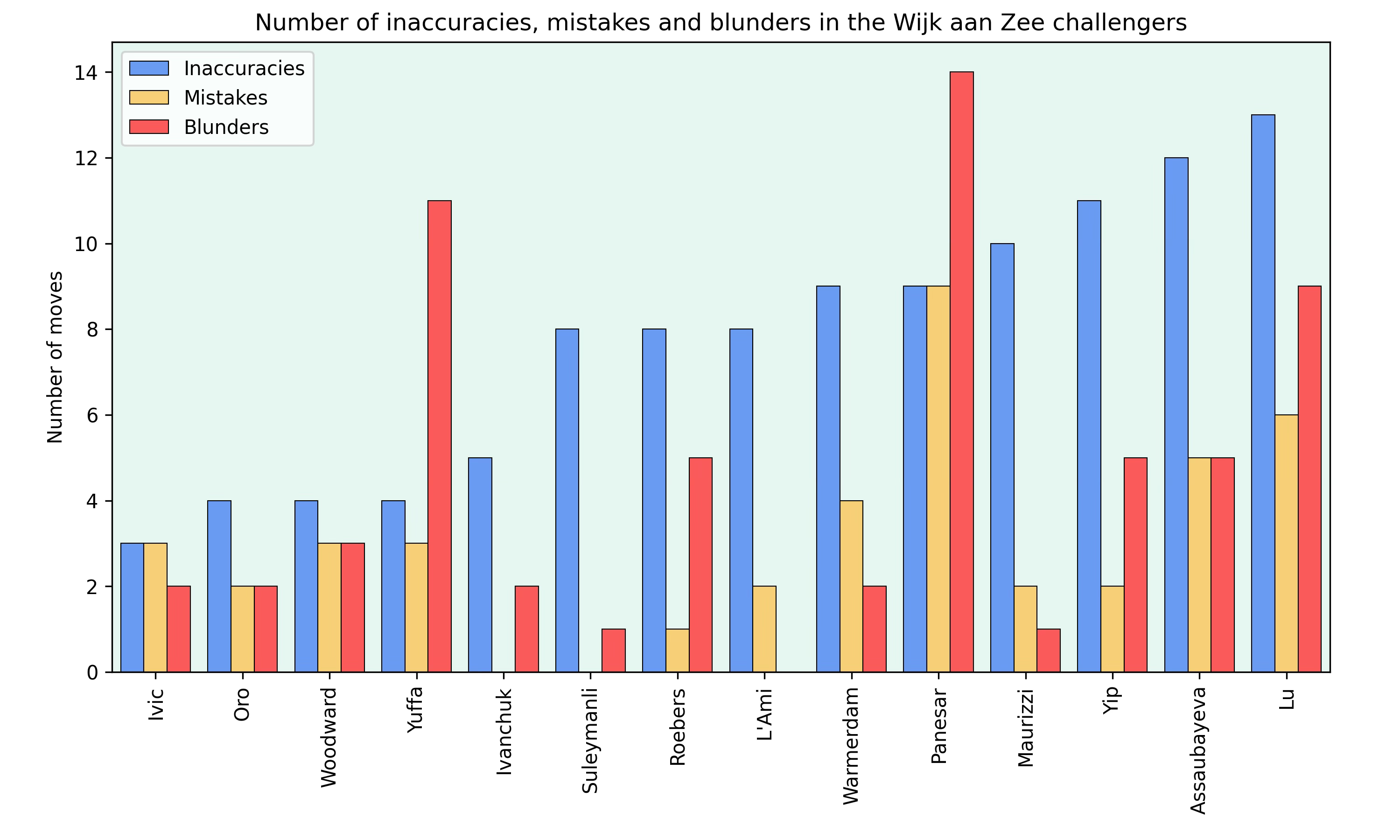
Faustino Oro looks very impressive in this graph, while Yuffa and especially Panesar made a lot of blunders.
The game accuracies tell a similar story to everything we’ve looked at so far.
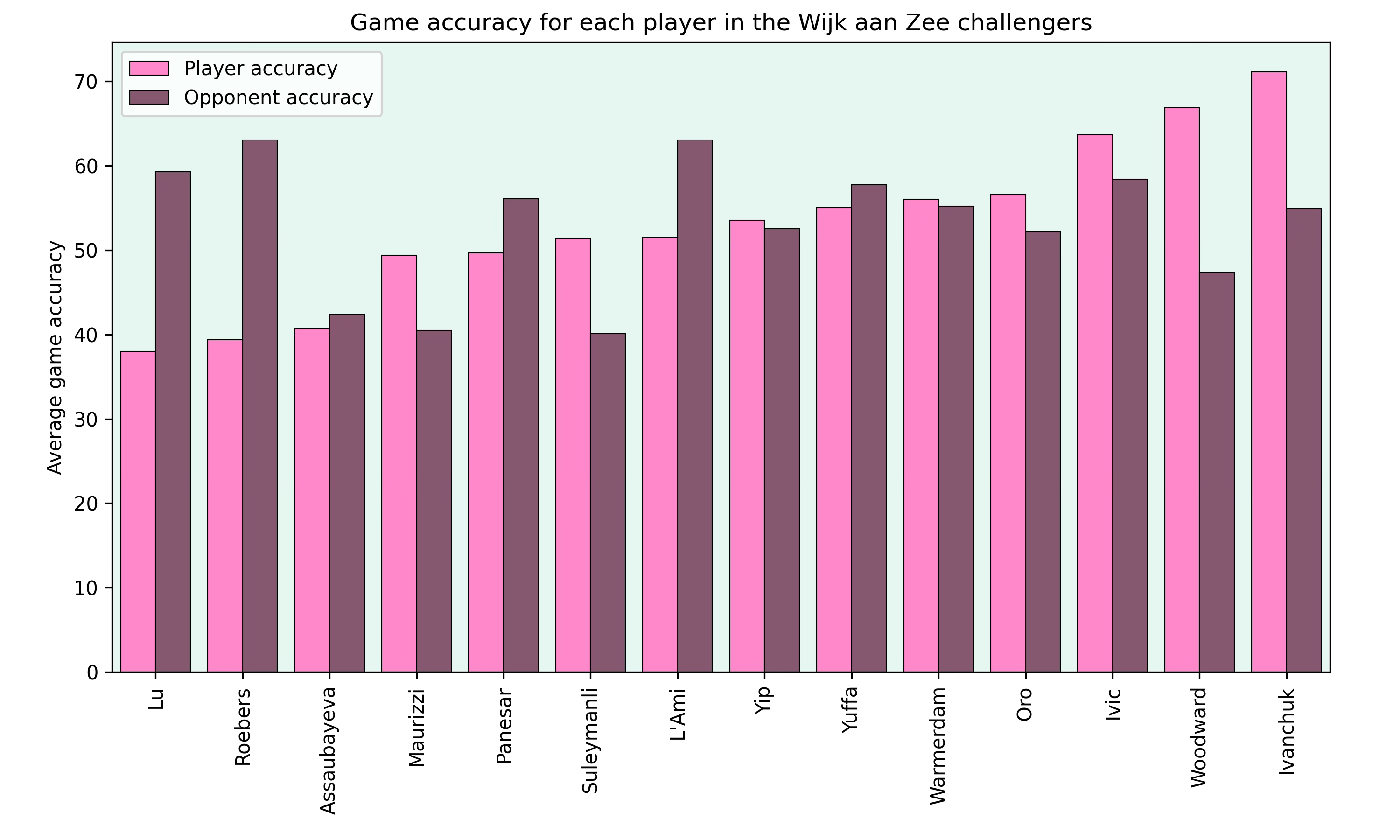
Again, the difference between the accuracy of the players and their opponents is important to look at and the top 4 finishers really stand out here. Ivic played very accurately, but so did his opponents, which usually indicates that the positions weren’t too difficult and he also didn’t have many decisive games.
Awesome work, as always Julian!
Cool and unique analysis!
Any ideas on why the opening selection was so different? Were the challengers more incentivized to go for wins as black?