
A Visual Recap of the 2026 Candidates Tournaments
Visualising key aspects of the most important tournaments of the year

Now that the Candidates tournaments are over, I want to take a look at some stats about both tournaments, as I’ve done previously for other tournaments.
Open section
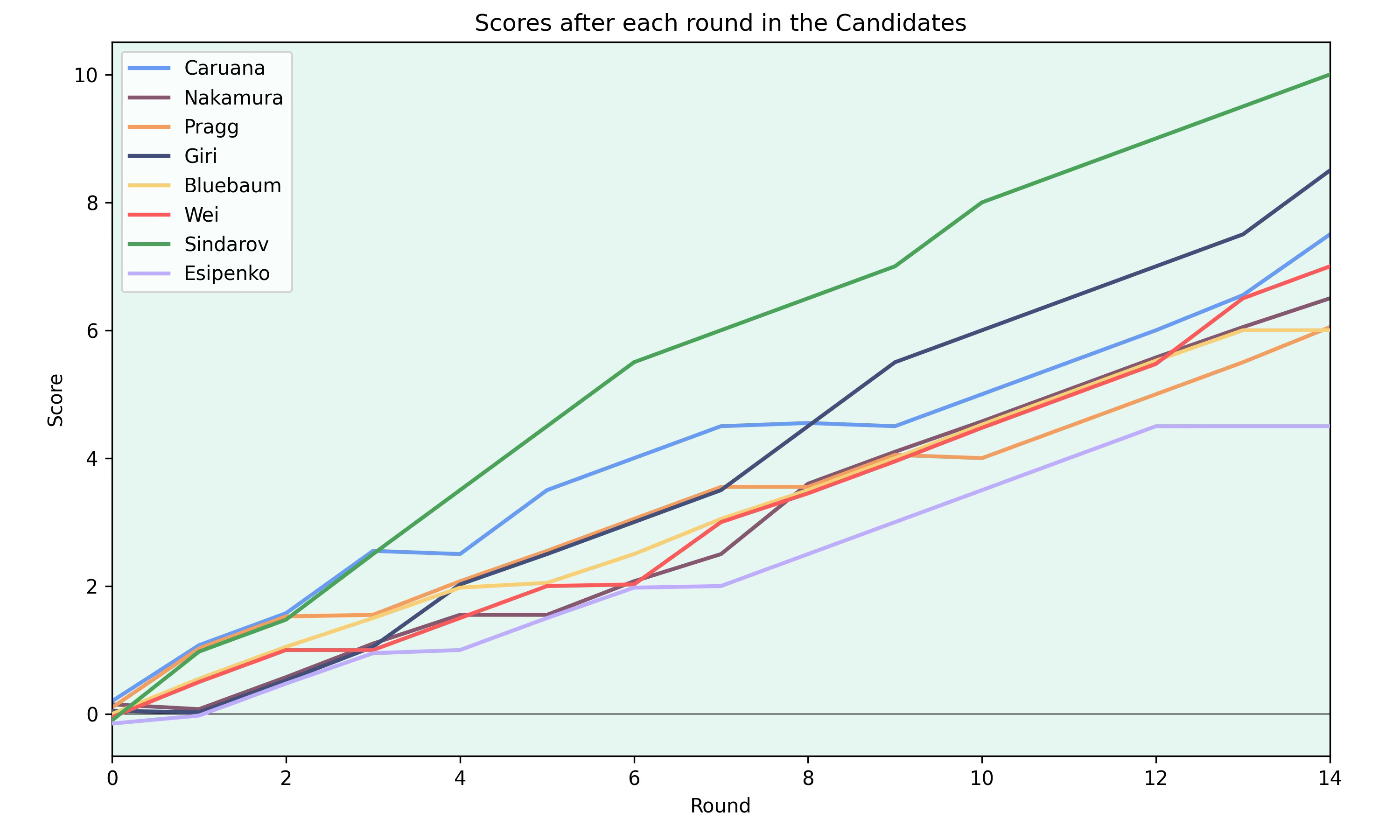
Score
The open section was defined by Sindarov’s historic performance, he started with 5 wins in his first 6. The gap between him and the field opened up after he defeated Caruana in round 4, who also started with 2.5 out of 3. After that, he was always at least one full point ahead of the field.
I also like to look at how well every player scored with white and black.
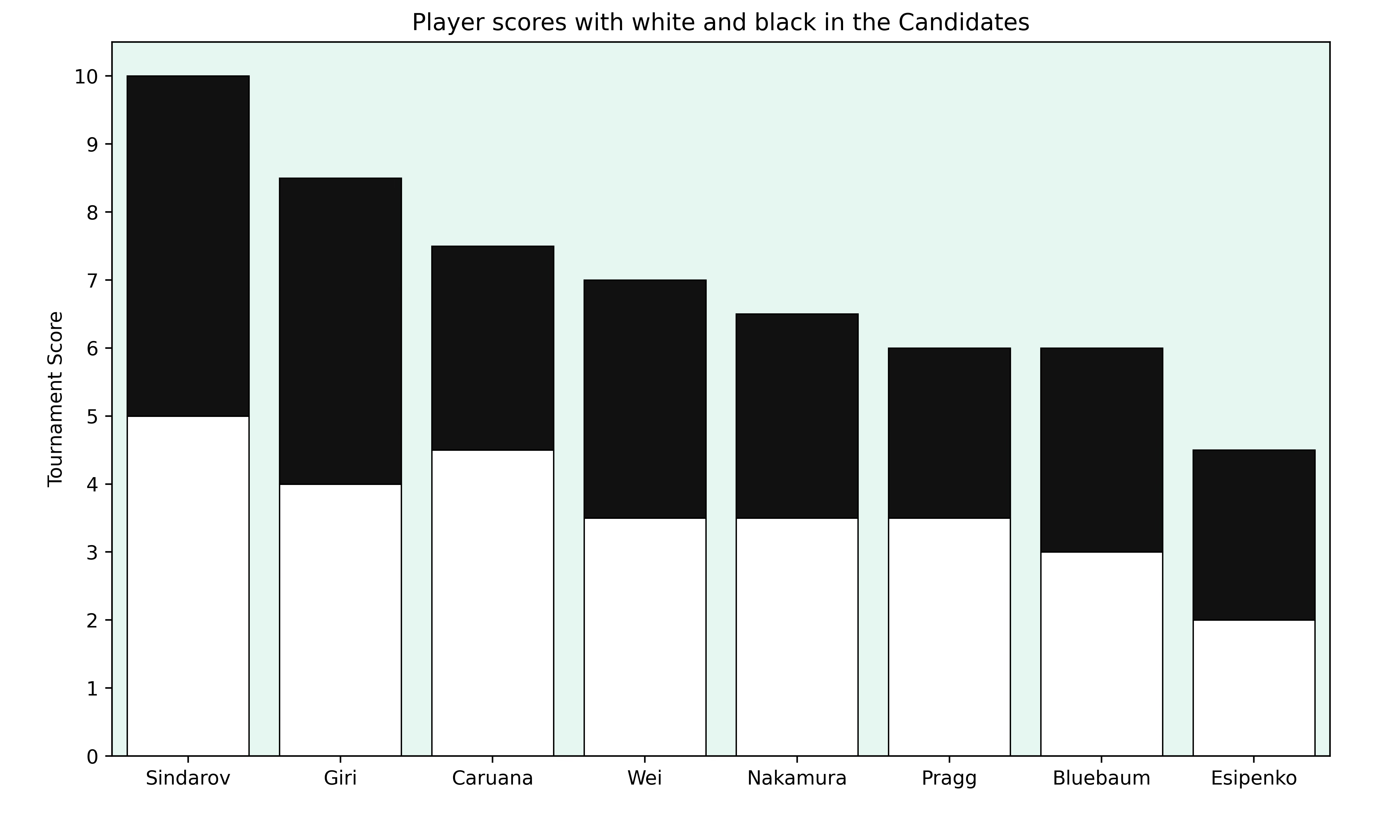
As Sindarov won most of his games in the first half of the tournament, it’s not surprising that he scored the same number of points with white and black. However, this seems to have been a general trend in the tournament.
Time usage
One thing that stood out in Sindarov’s play was the time usage, or rather the lack of it. He played quickly and was ahead on the clock in most games, which may have been particularly impactful since the players played without an increment before move 40.
To get a comparison to other players, I decided to plot the median time advantage of each player after every move in the tournament. I look at the time advantage instead of the total time left, as the time left is more impacted by quick games where both players knew all the theory.
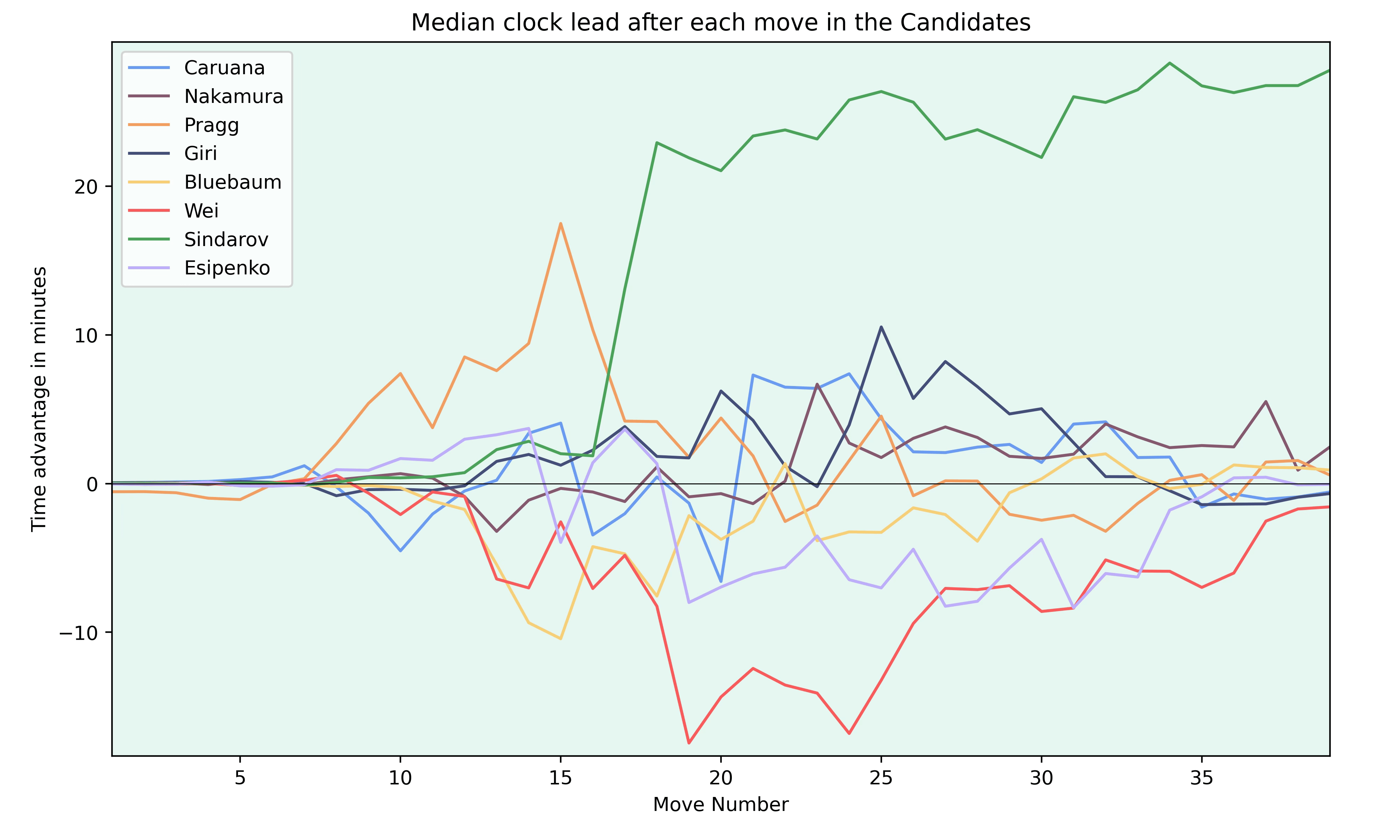
Sindarov is around 25 minutes ahead of his opponents from move 17 to move 40. No other player had any significant median lead on the clock after move 30.
One can also gather some interesting tidbits about other players. Pragg’s decision to spend around a minute before making his first move in every game can be clearly seen. He also had a good time advantage in the early middle game, which may be a sign of good preparation. Wei Yi on the other hand got way behind on the clock and only slowly closed the gap, probably since he needed to speed up to avoid flagging.
Better and worse positions
As usual, I also want to gather a bit more insight into how well the players actually played instead of just looking at the outcomes of the games.
Firstly, I want to look at the relative number of moves where the players stood much better (evaluation of more than +1), slightly better (evaluation between +0.5 and +1), equal (evaluation between -0.5 and +0.5), slightly worse and much worse.
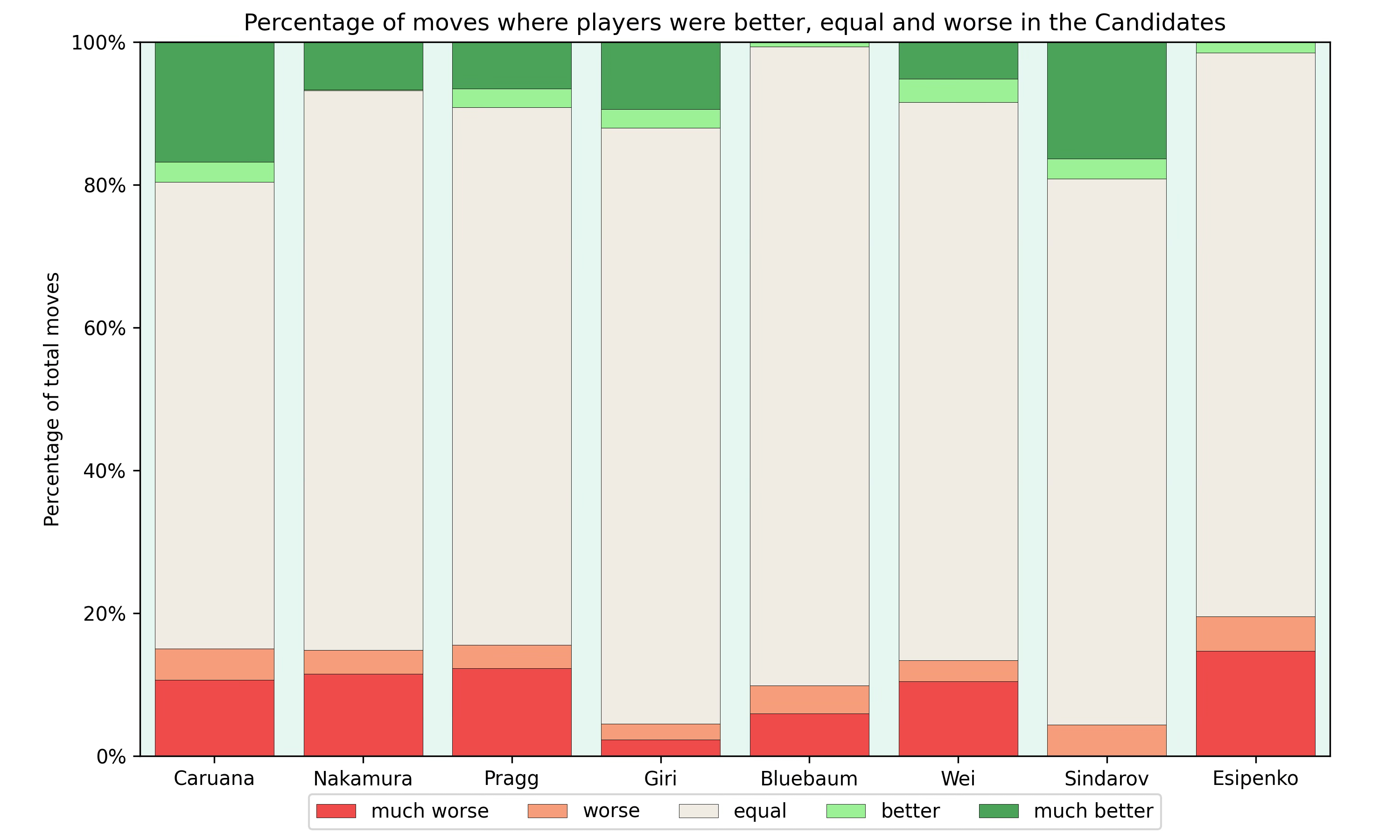
Sindarov stands out here, as he never had to defend a really bad position. Giri also managed to stay out of trouble most of the time, but didn’t get as many good positions as Sindarov. It’s also interesting that Caruana got a lot of good positions, but was also worse for many moves, which may reflect his risk taking in the tournament.
Only looking at evaluations only tells half the story, as players also need to convert their good positions. To get a sense of how well players were converting their advantages, I compared the number of wins each player had to the number of games where they stood better, which means that they had an advantage of +1 or more at least once in a game.
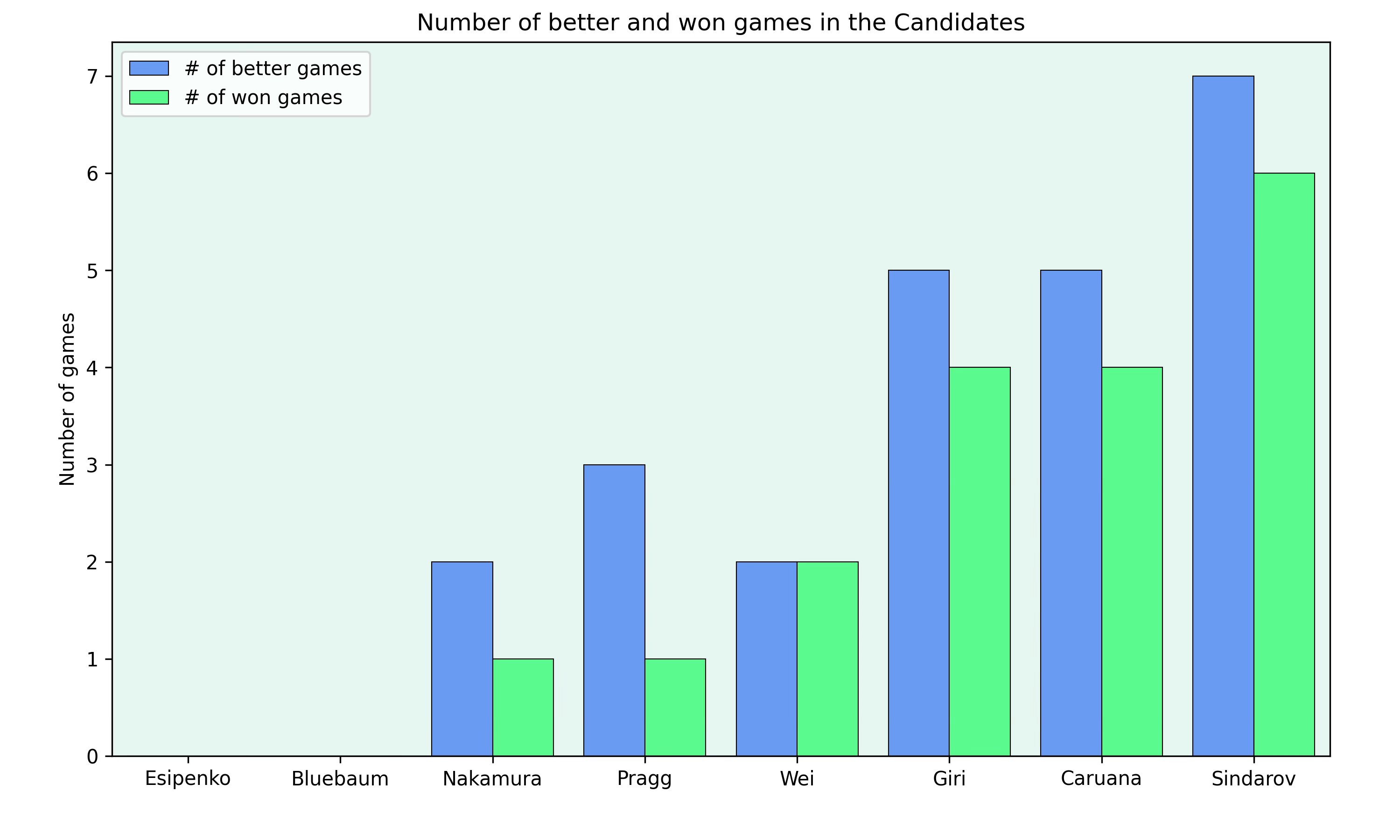
Wei Yi is the only player who managed to convert all games where he stood better into wins, but he just didn’t get enough good positions to challenge for the top places. Sindarov stands out by reaching a better position in half his games and converting almost all of them into full points.
We can also see how well players defended bad positions, by looking at the number of games where they stood worse compared to the number of losses.
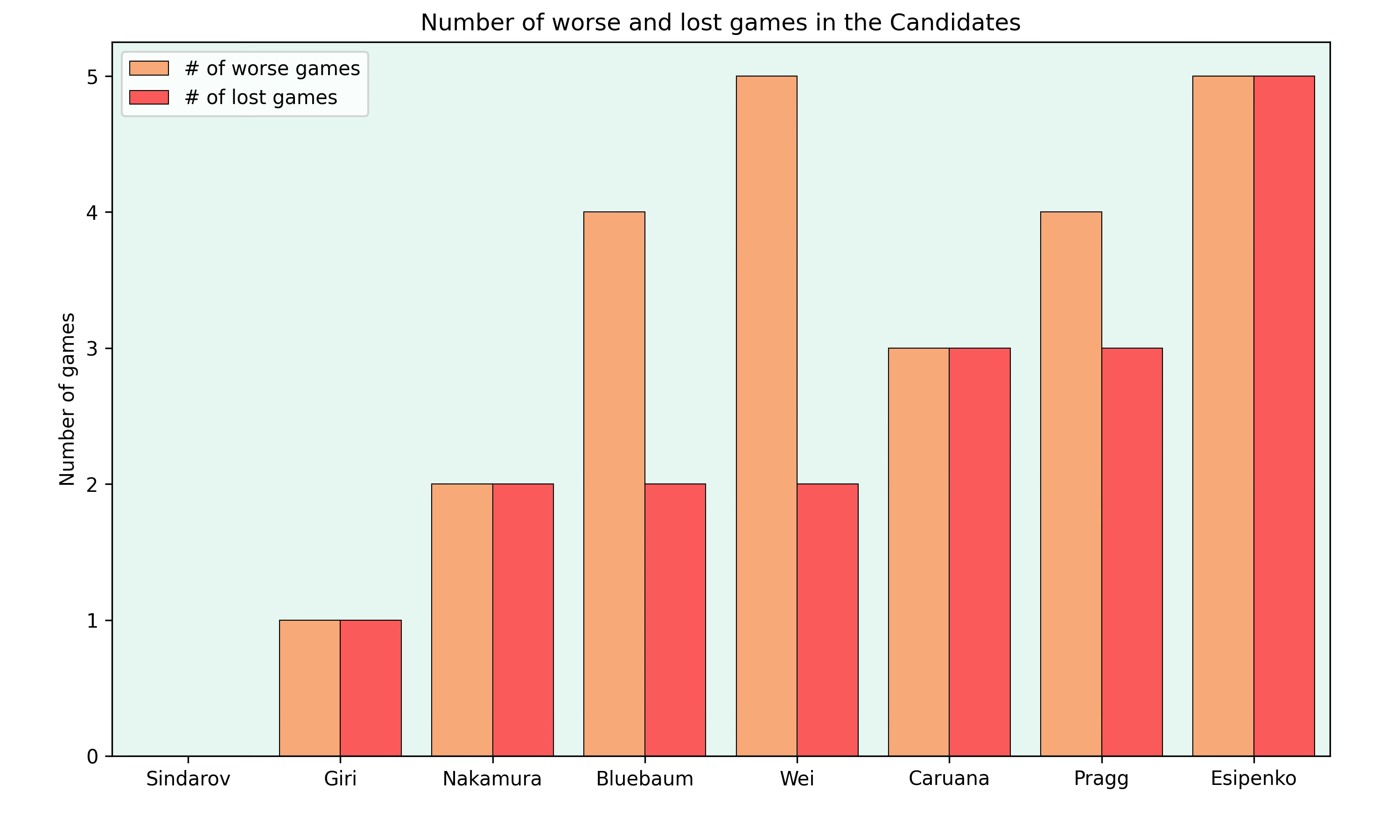
Once again, it looks like Wei Yi played a good tournament from a practical viewpoint, as he was worse in 5 games, but managed to save 3 of them. Of course, it’s even better to never be in trouble in the first place and that’s exactly what Sindarov managed to do.
Engine analysis
We can also look at some more classical analytical measures to get an idea of how well the players played.
Let’s start by looking at the number of inaccuracies, mistakes and blunders played by each player.
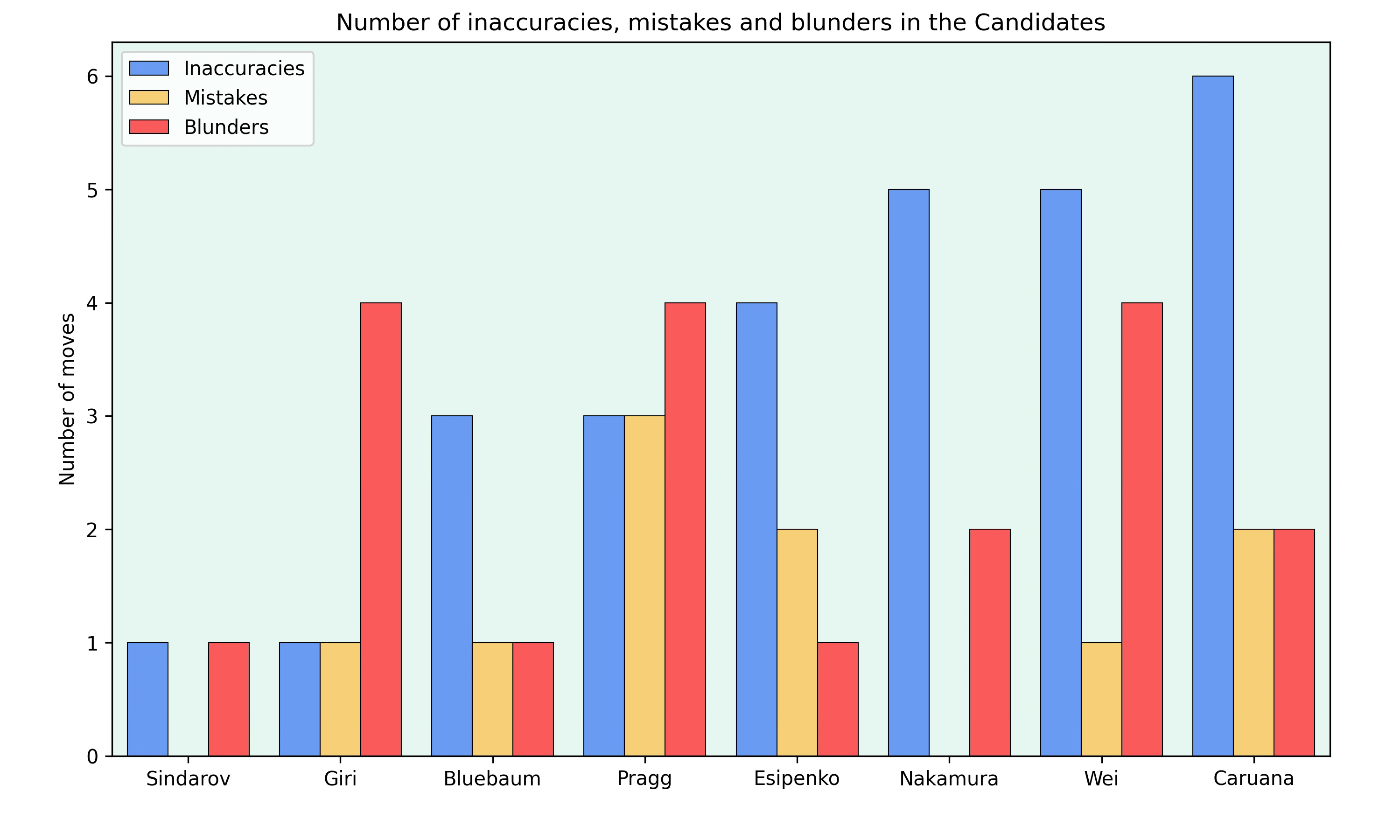
Again, it’s clear that Sindarov played an amazing tournament. His only blunder was the missed win against Blübaum when he was already far ahead in the tournament.
It’s interesting to see that Esipenko didn’t make many mistakes or blunders despite having a disappointing tournament overall.
We can also look at the accuracy of every player. As the accuracy depends heavily on the position on the board, I compare the accuracy for every player to that of their opponents.
Note that I use my own accuracy metric, which was calibrated using OTB grandmaster games, so the numbers are a bit lower than what you may be used to.
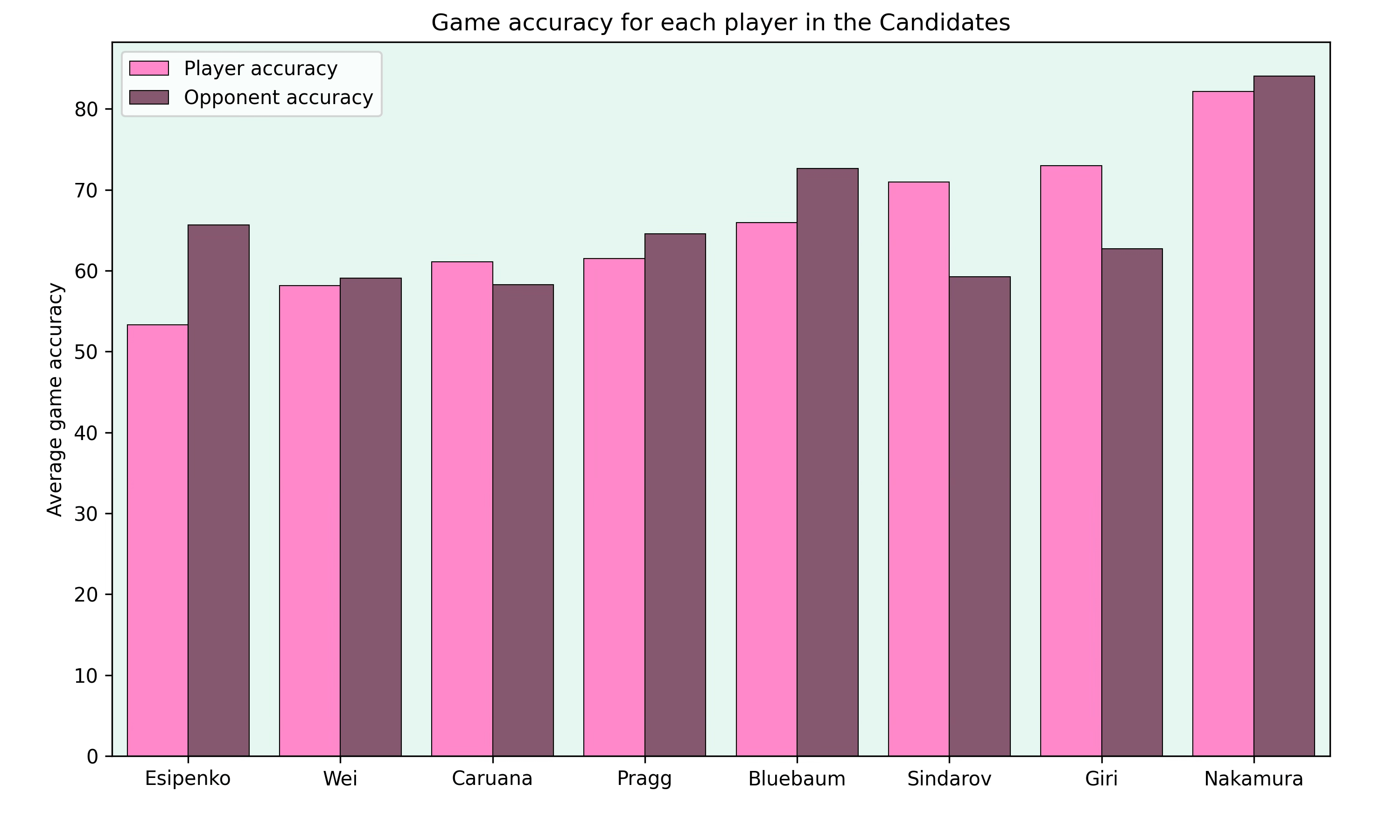
Nakamura had the highest accuracy, probably because he wasn’t too interested in getting complicated, fighting positions in the second half of the tournament.
I always find the difference between the accuracy of a player and the accuracy of their opponents more insightful. When looking at the difference, the two top finishers in Sindarov and Giri stick out.
Openings
Finally, let’s look at the openings played in the open section.
First if all, here is the frequency of the different first moves with white.
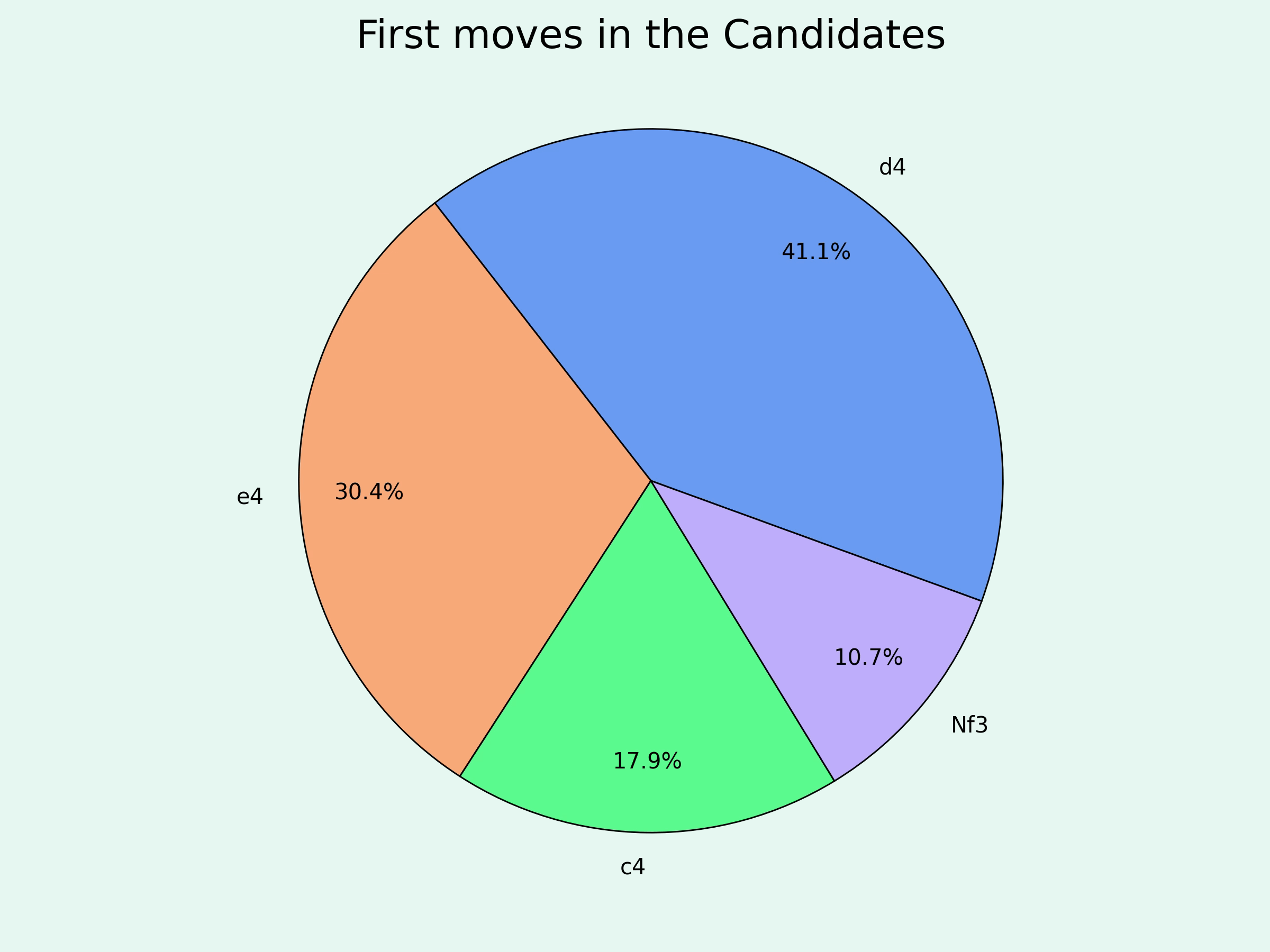
I’m surprised to see that only around 30% of the games saw 1.e4, probably because many of the participants wanted to avoid the Petrov.
We can also look at which specific openings were played.
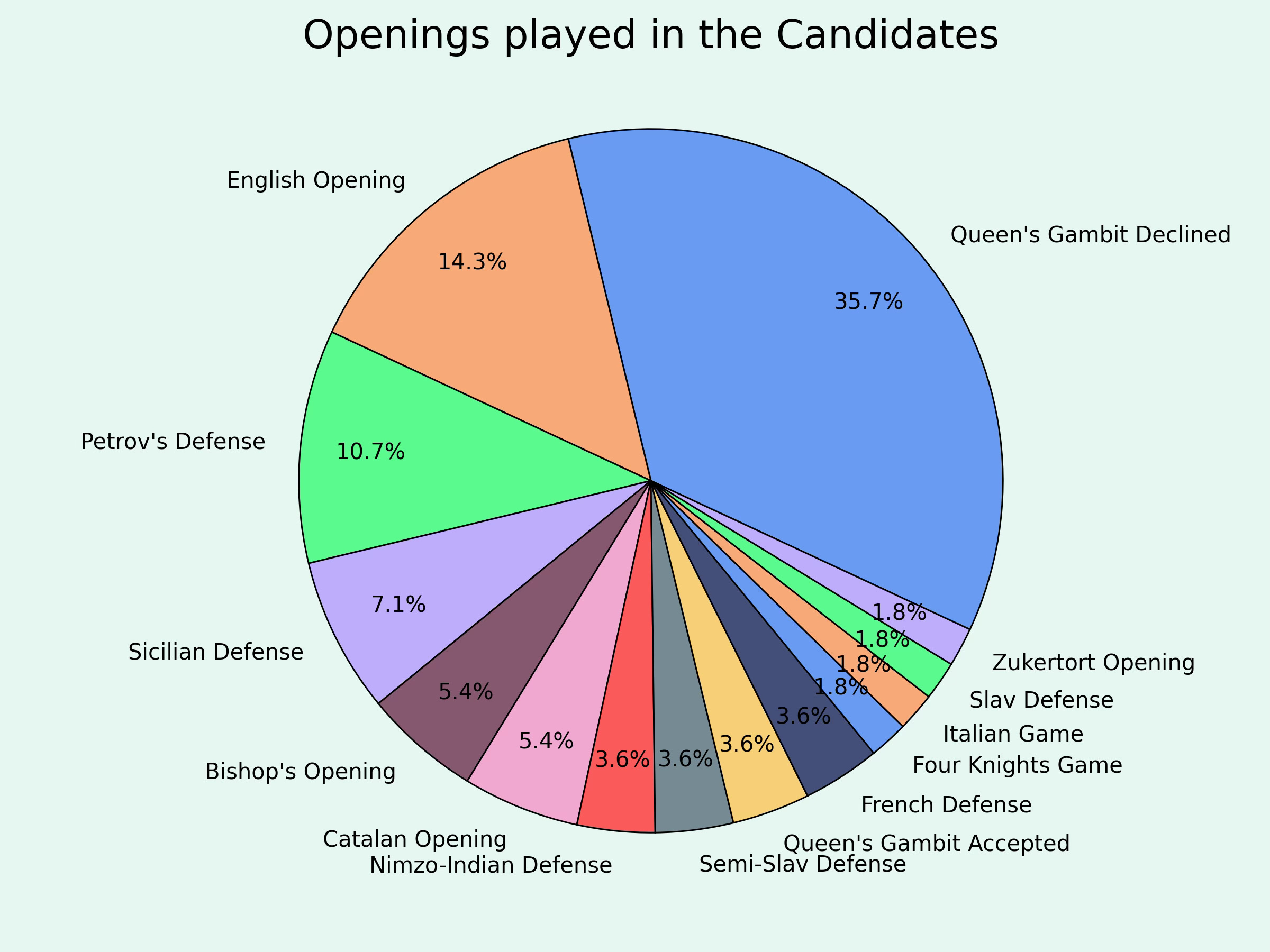
The QGD was by far the most popular opening in this tournament. Interestingly, there wasn’t a single Ruy Lopez and also only one Italian Opening in all 56 games.
Women’s section
Scores
While Sindarov ran away with the tournament in the open section, the women’s section was much tighter and more tense. There were multiple lead changes, which can be seen when plotting the score of each player after every round.
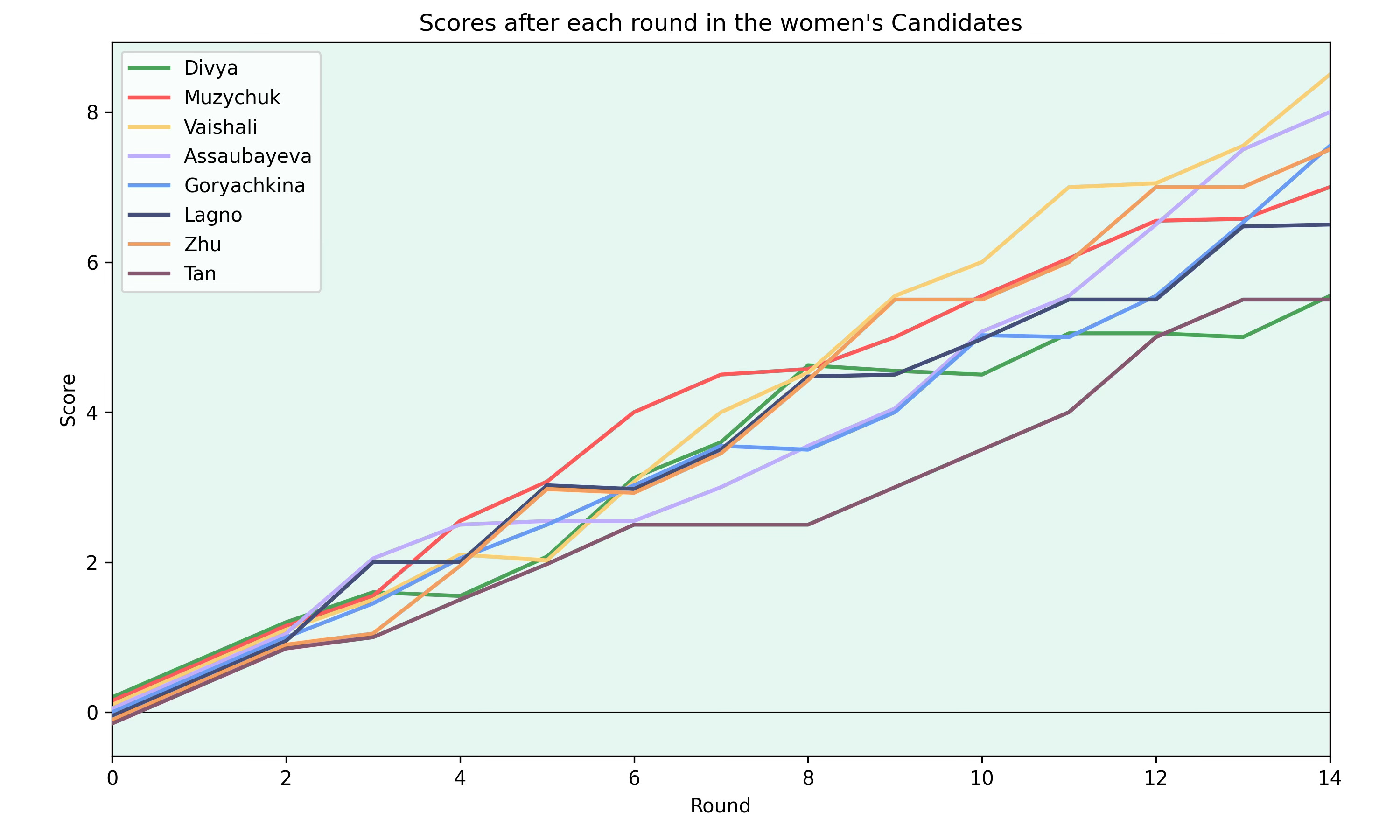
Vaishali took the co-lead in round 8 and stayed in first or tied for first for the remainder of the tournament, but there was always someone close behind her. First it was Zhu Jiner and then Assaubayeva, who was tied for the lead going into the final round. But Vaishali won that round and secured the tournament victory.
Splitting the scores by colours gives a more diverse picture than in the open section.
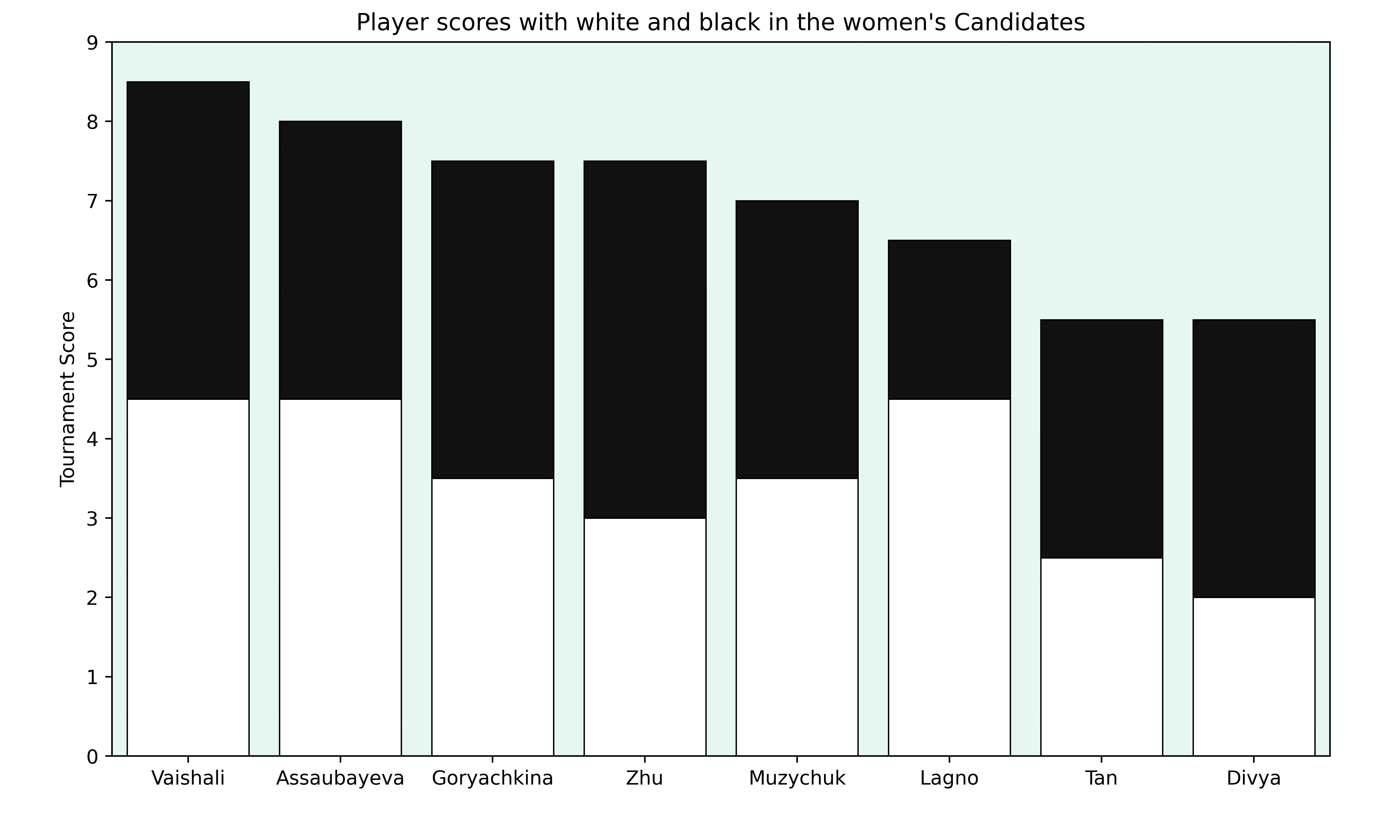
Here there isn’t a roughly even split between white and black for every player. Some players like Lagno scored much better with white, while the white games seem to have been a problem for Zhu Jiner and Divya.
Time usage
The women’s section was played with a more conventional time control of 90 minutes for the first 40 moves plus a 30 second increment from move 1. So time trouble may have been less of an issue, but I still wanted to look at the median lead on the clock for every player.
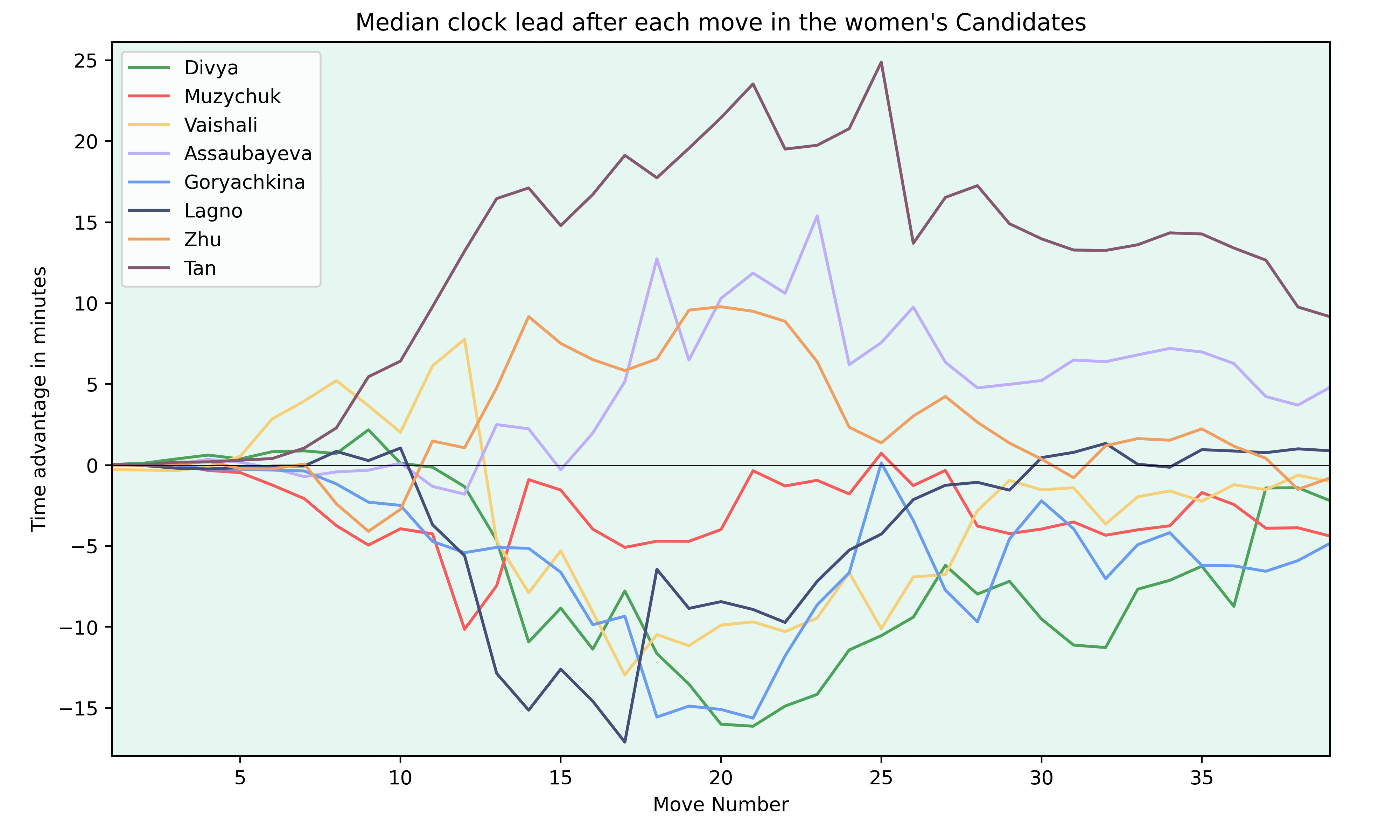
I hadn’t noticed that Tan played so quickly throughout the tournament, but she had by far the biggest median lead on the clock. It’s interesting that most players fall into one of 2 categories, they either start to pull ahead on the clock around move 15 or they start to fall behind.
Better and worse positions
As I did for the open section, I now want to look at the number of better and worse positions for each player.
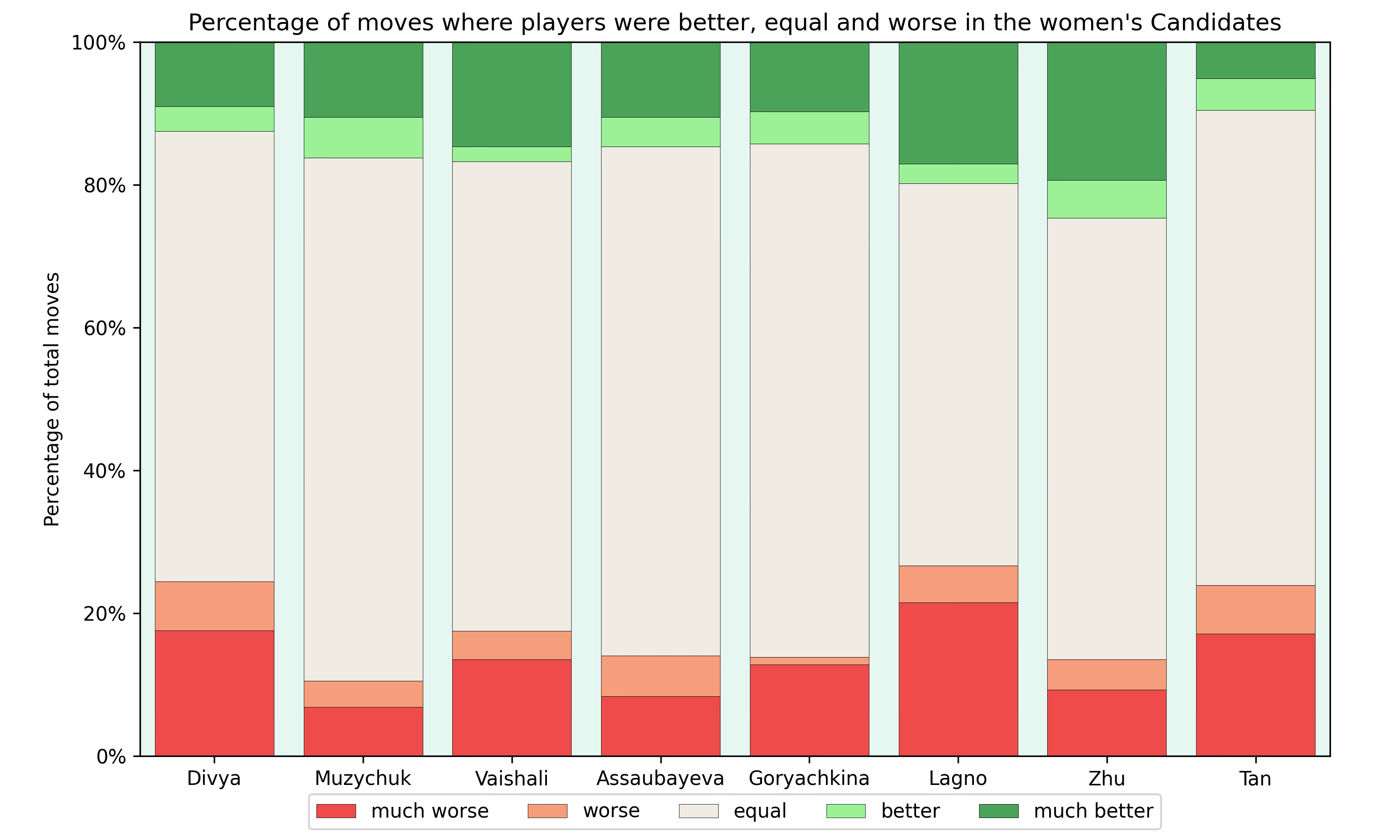
This picture shows that everything was tighter in the women’s section compared to the open. Every player stood much worse for a decent amount of the moves, but at the same time, everyone also had many good positions.
Looking at the number of better and won positions gives an indication on how the tournament was won.
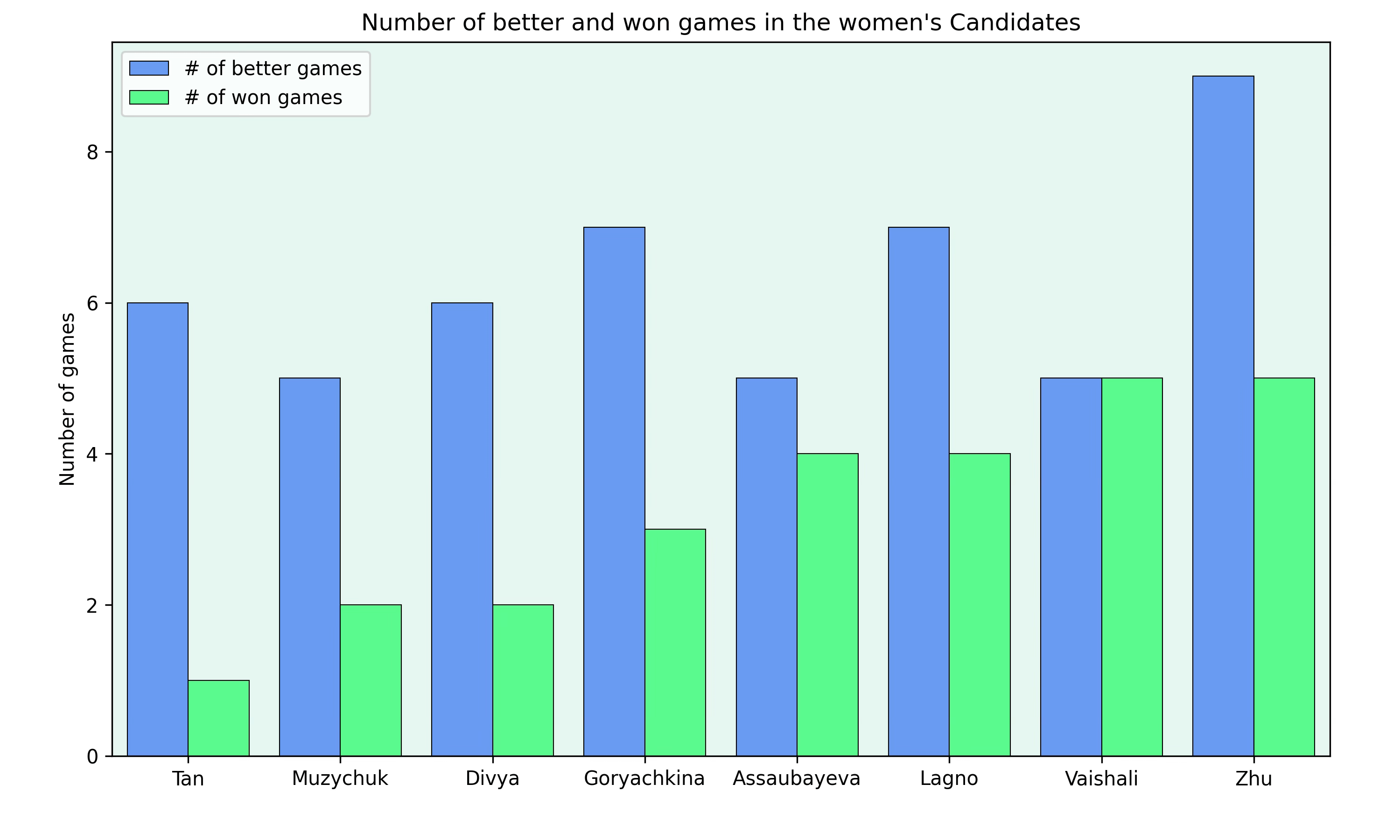
While Sindarov generated the most chances in the open section (and converted a good amount of them), Vaishali won the tournament by her efficiency. She converted every good position into a win, which lead to the joint highest number of wins in the tournament, while having the least games where she stood better.
A similar trend can be seen when looking at the bad and lost positions.
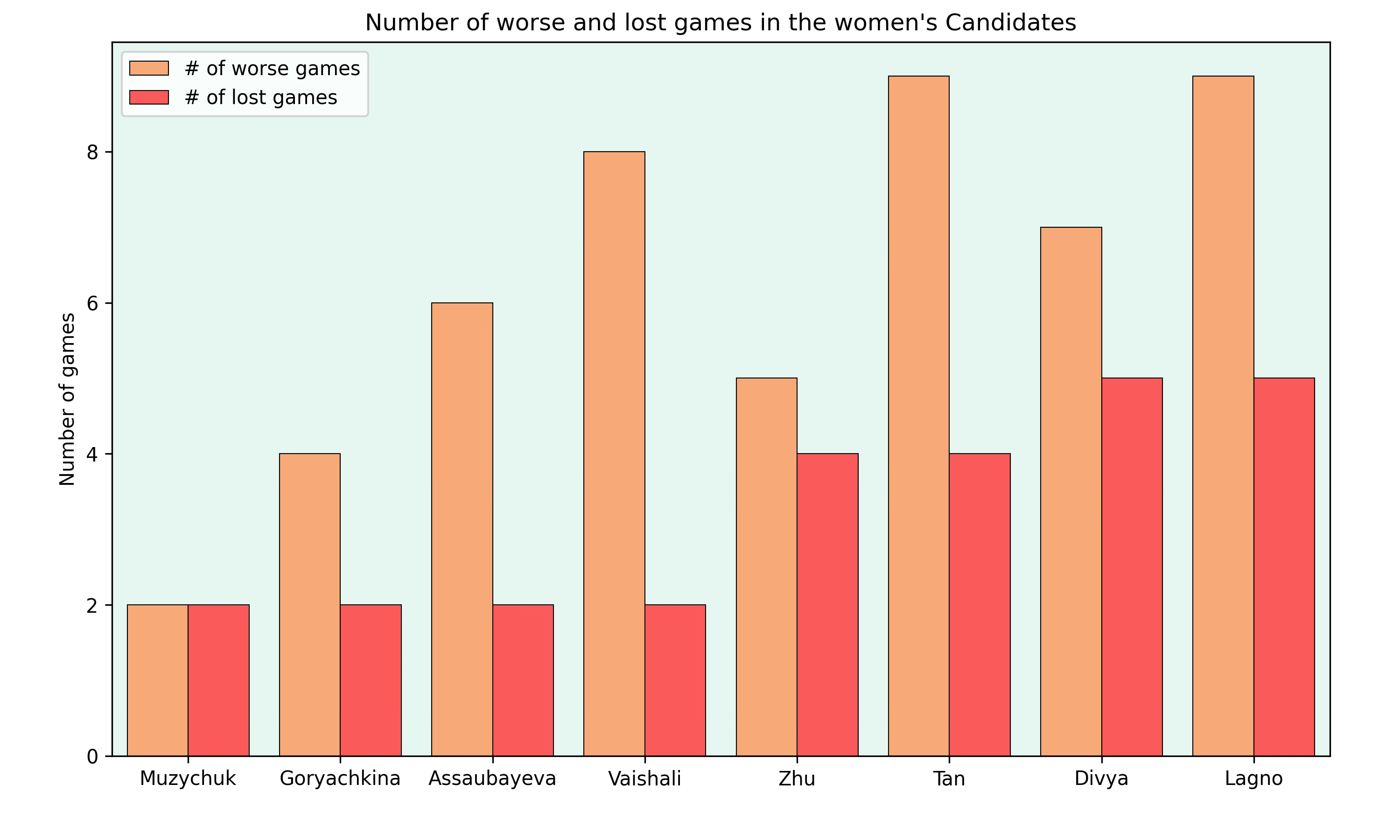
Vaishali had a bad position in 8 of her games, but she managed to save 6 of them, which was essential for the tournament win.
Engine analysis
Looking at the number of inaccuracies, mistakes and blunders in the women’s section again shows that
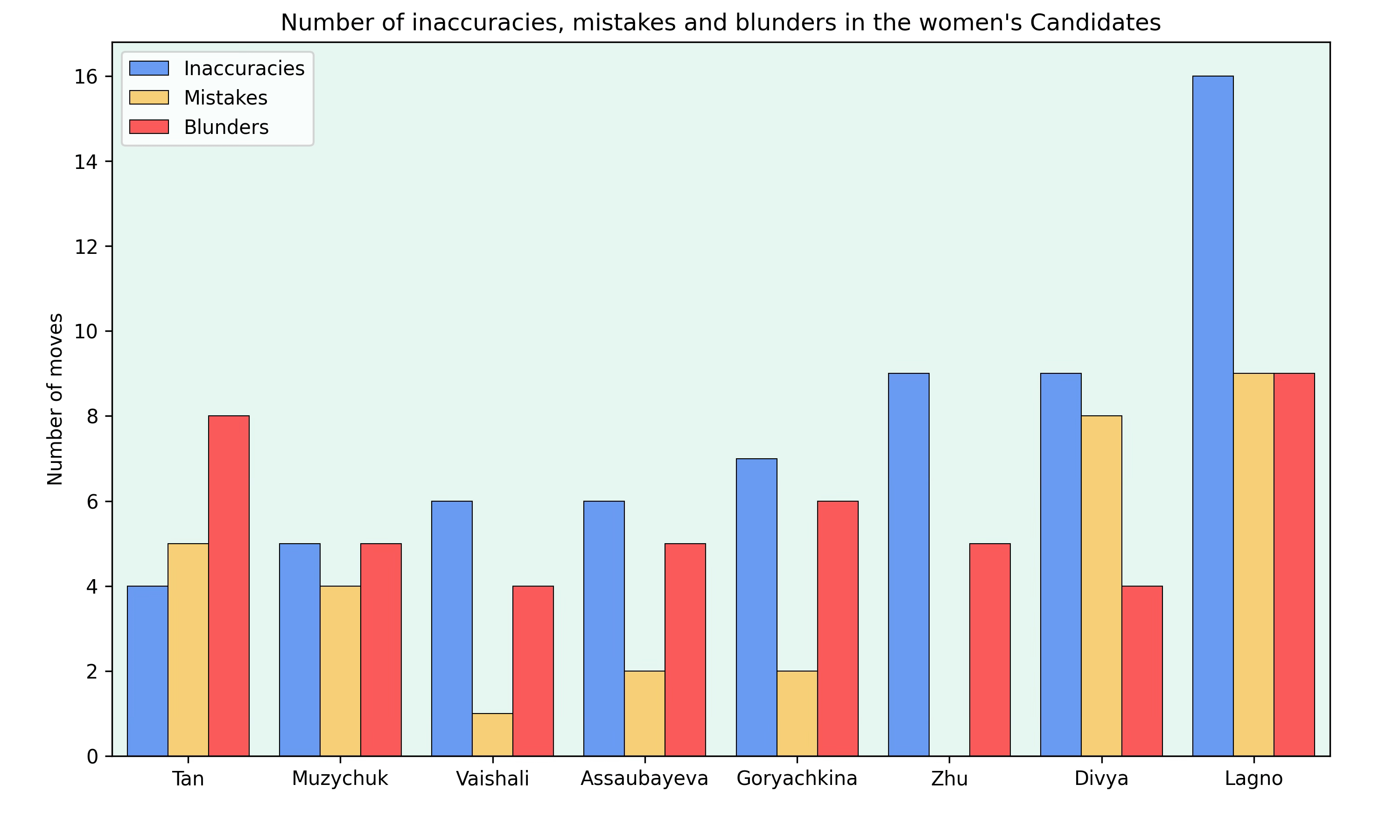
Again, there isn’t one player that sticks out here, but Vaishali and Zhu committed the least number of mistakes and blunders.
Looking at the accuracy of the players shows once again that being accurate isn’t enough to win tournaments at a high level.
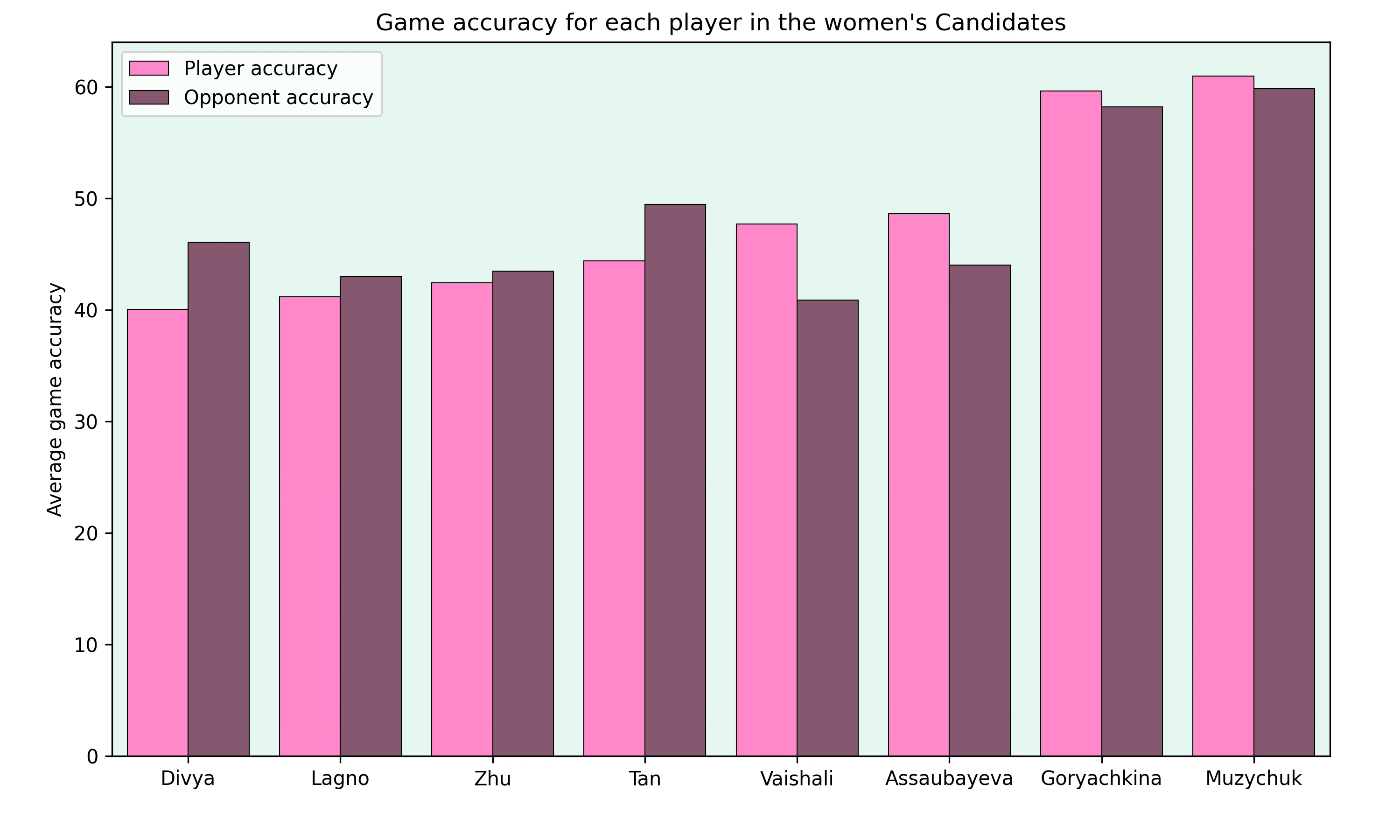
Again, the eventual top 2 finishers in Assaubayeva and especially Vaishali stick out by playing significantly more accurately than their opponents.
Openings
When looking at the first moves played in the women’s section, it’s a mirror image of the open section.
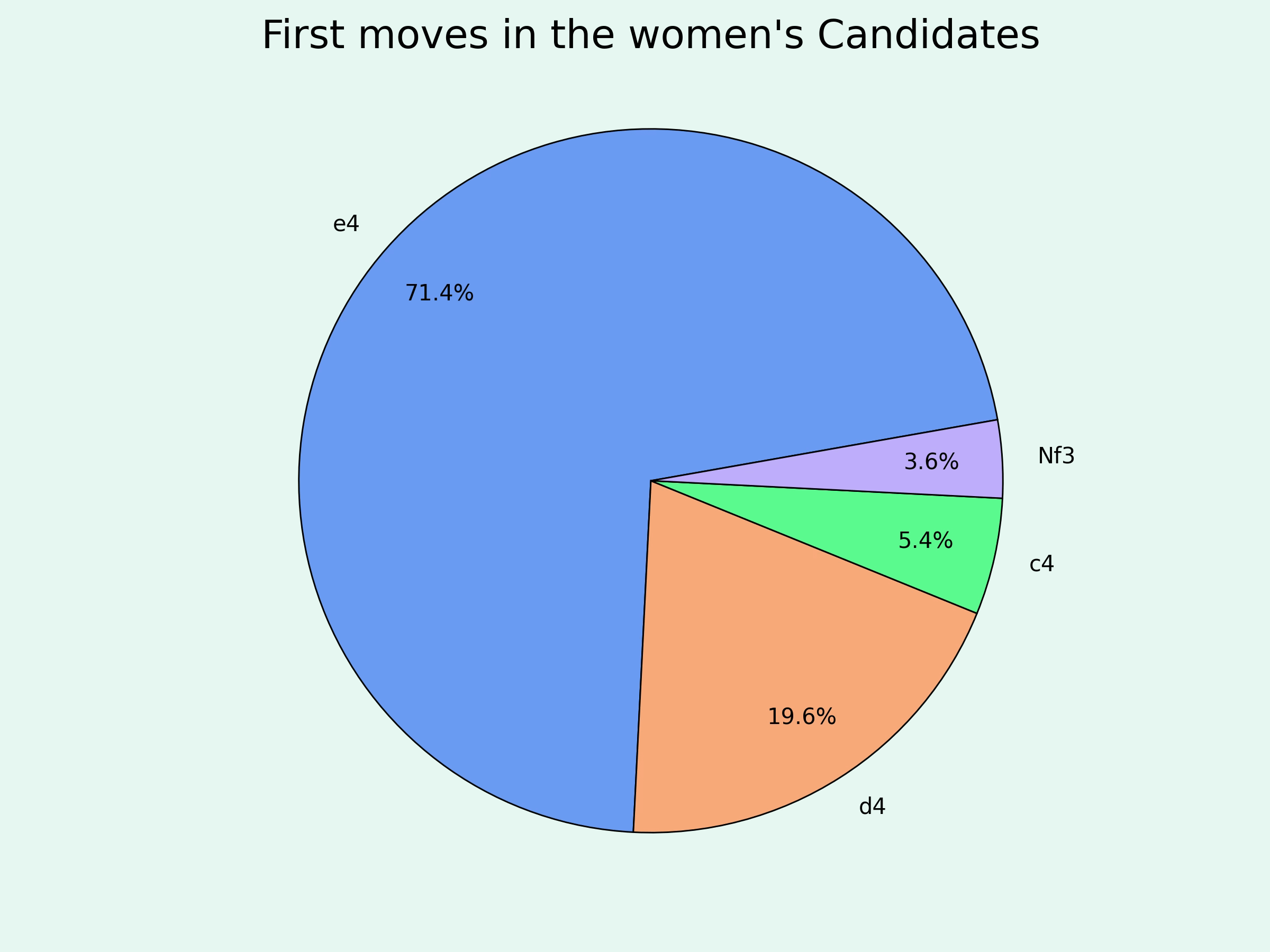
1.e4 was by far the most popular first move, with 1.Nf3 and 1.c4 appearing in only 2 and 3 games respectively.
There was also a greater variety of openings and I needed to group openings that appeared only once together to make the graph legible.
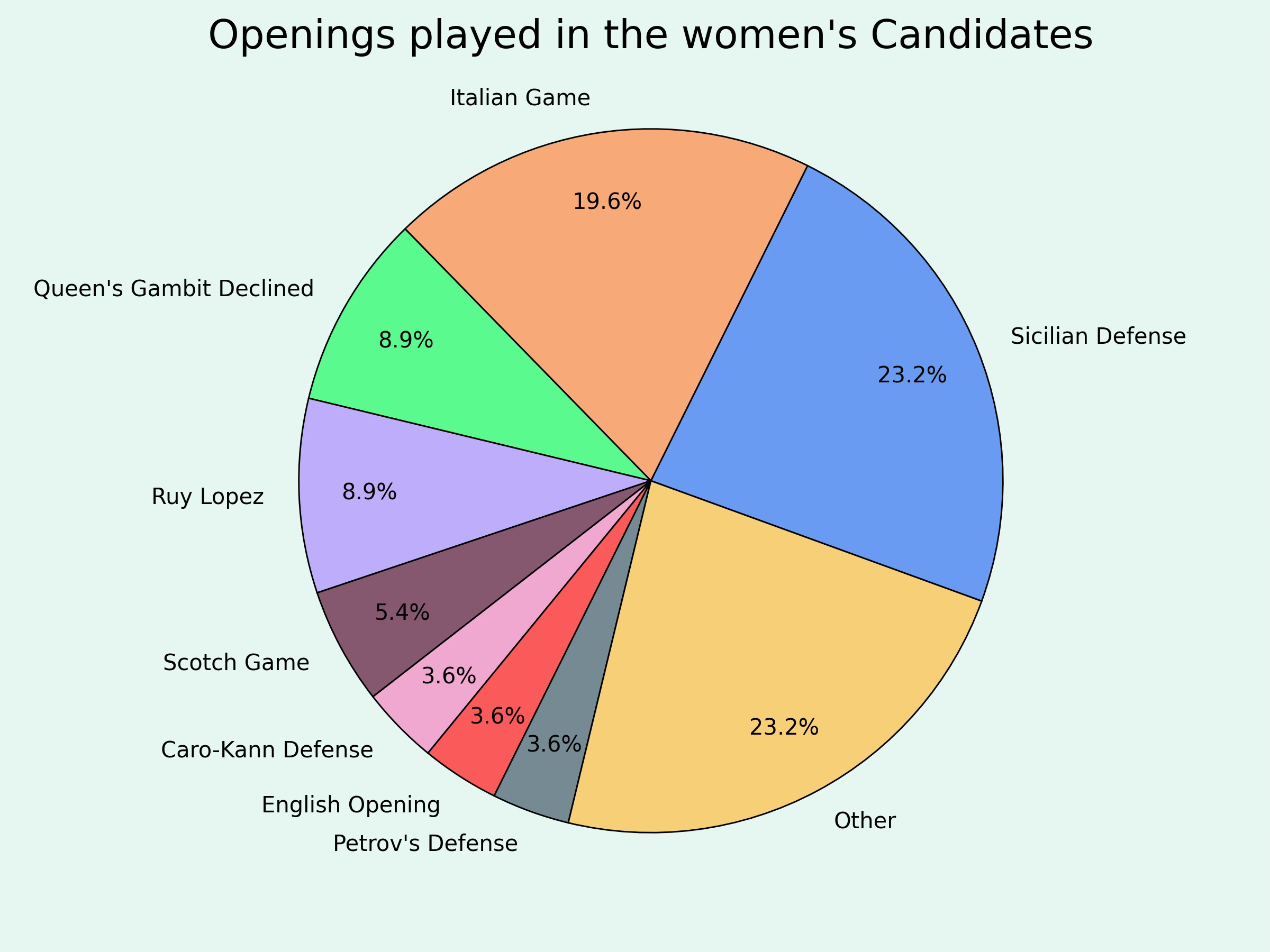
The Italian and Ruy Lopez also got more love in the women’s section, while the Scotch was also surprisingly popular.
Great data, thanks as always for your quality work Julian.
As you alluded to, the lack of 1.e4 in the Open section was likely related to white players not wanting to play the Petrov (which Blübaum and Wei Yi were especially prepared in). Wei Yi didn't get the memo though as he opened with e4 every white game.
Even when white found themselves in a Petrov, the lines they chose were often very offbeat.